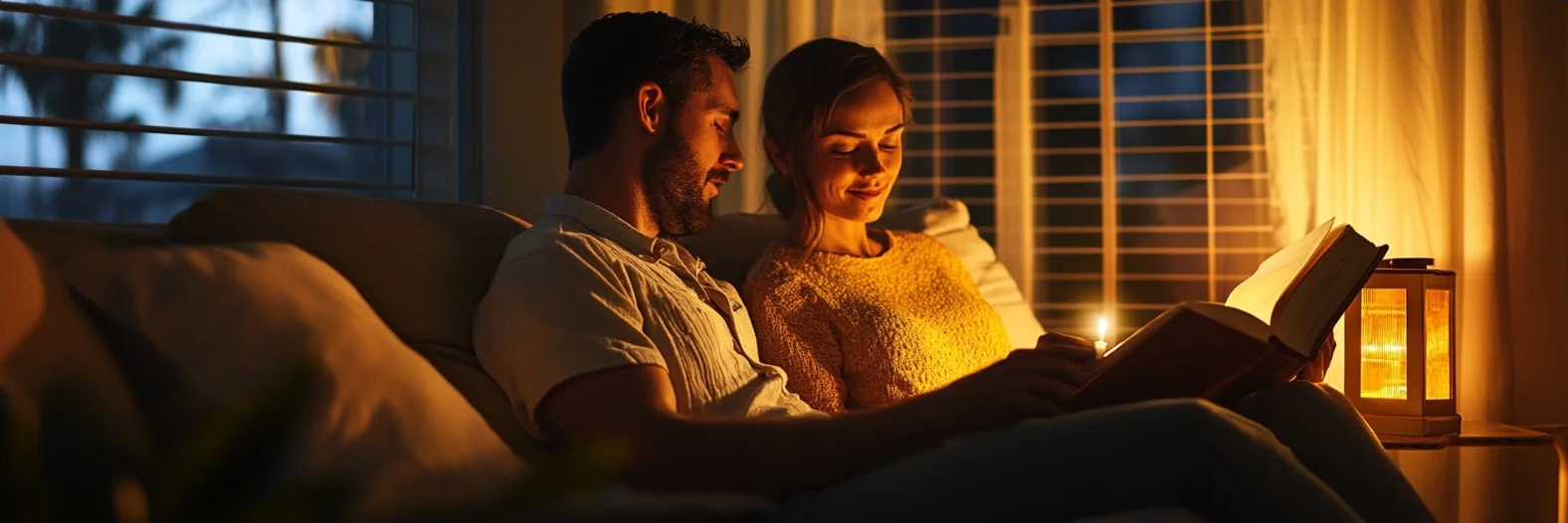
The television has been off for four days. Your phone battery is at 30% and you're conserving it. The kids are asleep. It's 9pm, the lantern is lit, and you have two hours. Here is what Florida adults have discovered โ some for the first time โ about life without screens.
Ask any Florida resident who has lived through a week-long or longer power outage what surprised them most, and a remarkable number say some version of the same thing: they read more in that single week than in the previous year. They had conversations with their partner that had not happened since before the children were born. They remembered that they actually like music โ not as background noise but as the thing itself, listened to on purpose. They started a project they had been putting off for two years.
This is not nostalgia or manufactured positivity. It is what happens when the screens โ the ambient noise generators that fill every idle moment of modern life โ are removed, and the silence has to be filled with actual life. Some of what fills it is uncomfortable. A lot of it turns out to be surprisingly good. Some of it becomes something people deliberately return to after the power comes back on.
The first 24 hours without screens is genuinely uncomfortable for most adults. The automatic reach for the phone that finds nothing. The impulse to turn on the television that immediately fails. The low-grade restlessness that comes from being cut off from the constant dopamine flow of digital content. This is a real withdrawal response, and it is temporary. By day two or three, most adults settle into a different rhythm โ slower, more deliberate, more present. The adjustment is real. What comes after it often surprises people who have spent years moving too fast to notice.
The power outage is the great equalizer of e-readers and physical books. E-readers last several weeks on a charge, but physical books require nothing but light. One LED lantern provides enough for comfortable reading. A good novel occupies the part of the brain that would otherwise be running anxious loops about insurance adjusters, repair estimates, and when the power is coming back. The immersive absorption of fiction is not escapism during a hurricane recovery โ it is effective self-regulation.
Days 1โ2: Escapist fiction. Thrillers, mysteries, fantasy, romance โ anything that pulls you completely out of your present circumstances. This is not the week for improving nonfiction about financial planning or professional development.
Days 3โ7: Long narrative nonfiction you've been meaning to read. The extended power outage is reliably when people finally read the 500-page history or memoir they bought two years ago. Slow, absorbing, deeply researched books work beautifully with unlimited unstructured time.
Any day: Short story collections. If concentration is difficult (it often is in the first day or two), short stories give the complete satisfaction of a finished narrative in 20โ30 minutes. Anton Chekhov. Raymond Carver. Flannery O'Connor. Alice Munro. These writers built their careers on stories that can be read by a single lantern without losing anything.
Before hurricane season, visit your library and check out 8โ10 books. The standard checkout period covers a typical extended outage, the books are free, and a mixed selection โ adult fiction, something for teenagers, something for younger kids โ means the entire family is covered. Your library card is one of the most useful hurricane preparedness tools you have, and it costs nothing.
A Bluetooth speaker paired to a phone in airplane mode, playing locally downloaded music, can provide weeks of listening. Most streaming services allow offline downloads before the storm. What becomes possible during a power outage is something most adults have not done in years: listening to a full album, start to finish, without multitasking. No scrolling. No other task. Just the music. Rediscovering music you actually love โ as opposed to the algorithmically generated ambient soundtrack of normal life โ is one of those activities that feels almost radical after years of distracted streaming.
An acoustic guitar. A harmonica ($15 at any music store, playable within an hour of picking it up). A ukulele. A djembe drum. Instruments that operate entirely on human energy have never been more relevant than during a power outage, and Florida's long porch culture has always known this. You do not need to play well. You need to play. The focused attention, physical engagement, and sound-making that come from any instrument are among the most effective stress-management tools available without a prescription. If you own any instrument that has been sitting untouched in a closet, a hurricane power outage is the exact right time to get it out.
Extended power outages have launched an improbable number of projects. Photo albums assembled from boxes sitting in closets for a decade. Real letters written to family members โ on paper, with stamps. Recipe collections compiled from handwritten cards and memories. Paintings started. Furniture repaired with the tools that have been in the garage for three years. Books begun. When the screens that fill every idle moment are removed, the projects that live in the background of your consciousness finally have space to emerge. Many Florida residents describe starting something during a power outage that became a lasting practice afterward.
A 1,000-piece jigsaw puzzle represents approximately 8โ10 hours of absorbing activity. It occupies the hands and the pattern-recognition architecture of the brain in a way that is deeply calming without requiring the sharp focused attention that reading demands โ which makes it useful at different energy levels and times of day. Multiple people can work on it simultaneously, creating a natural social context. Progress is visible every session, which provides genuine satisfaction during a period when many things feel stalled. Several Florida families have glued and framed the puzzle they completed during a power outage as a deliberate record of that period. It is a better artifact than the insurance paperwork.
A power outage in a Florida suburban neighborhood dramatically reduces light pollution. On a clear night two or three days after a storm, the sky over neighborhoods that normally barely show stars is suddenly full of them. This never fails to stop people. Bring a chair outside after 9pm, let your eyes adjust for 20 minutes, and look up. A stargazing app downloaded while you had data will tell you what you are looking at. Bring a blanket. Bring a drink. This is free, requires nothing, and consistently produces one of the clearer feelings of perspective available to people carrying the weight of hurricane recovery.