By State
🌴 Florida ⭐ Texas 🎷 Louisiana 🌊 Mississippi 🏖️ Alabama 🍑 Georgia 🌴 South Carolina 🏔️ North Carolina 🦅 Virginia 🦀 Maryland 🗽 New Jersey 🌆 New York 🦞 Massachusetts
Shutter Types
🪗 Accordion ⬇️ Roll-Down 🌺 Bahama 🏛️ Colonial 🛡️ Storm Panels 🕸️ Hurricane Screens 🪟 Impact Windows ↔ Accordion vs Roll-Down ↔ Shutters vs Windows
Guides
🧮 Cost Calculator 🤖 AI Pricing 📋 The Process 🔨 DIY Shutters 🪵 Plywood Guide 🔧 Maintenance 🛒 Supplies 🏷️ AirTags & Security 📋 Family Emergency Plan
After the Storm
🆘 Disaster Help Hub 🛡️ Post-Storm Safety 🌡️ Heat Safety 🐾 Pets & Livestock 🏠 Roof Tarping 💧 Water Damage 🌳 Tree Removal Florida Recovery Texas Recovery NC Recovery
Verify Contractor
Florida Texas Georgia North Carolina Virginia New Jersey New York Massachusetts
Free Estimate →
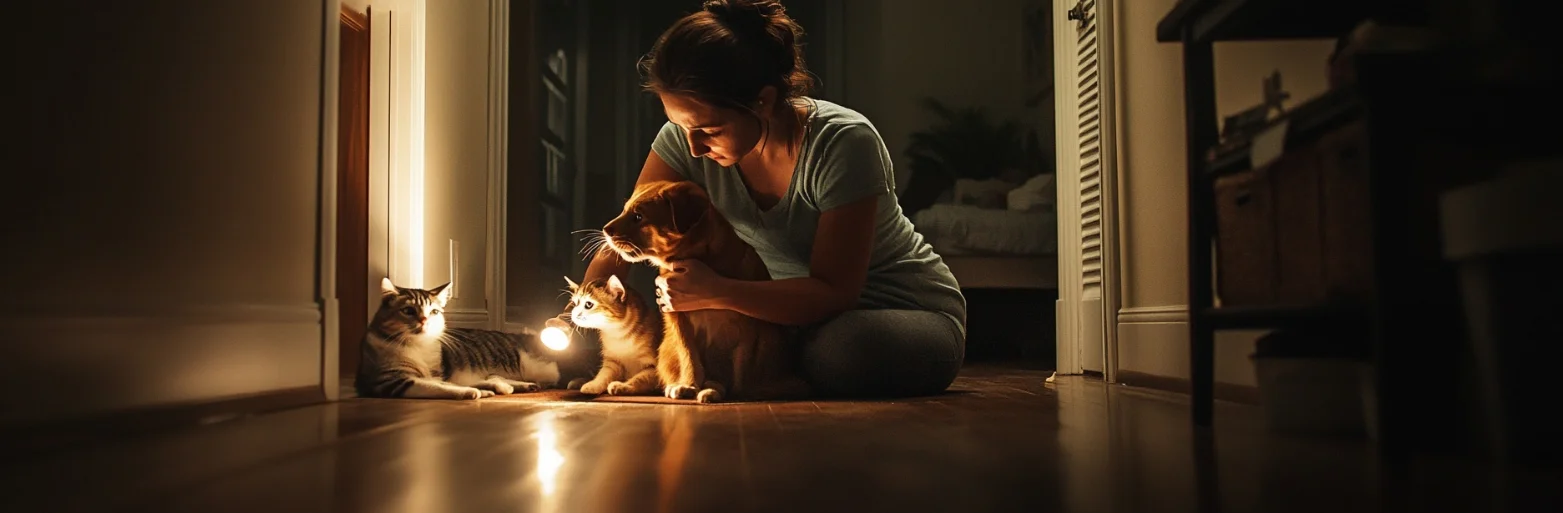
Woman comforting pets during hurricane
🐾 Hurricane Preparedness · Pets & Livestock

Hurricane Safety for
Pets & Livestock

Animals face the same post-storm hazards as people — nails, glass, floodwater bacteria, downed power lines, mold, and displaced wildlife. Complete guide to protecting your animals before, during, and after a hurricane.
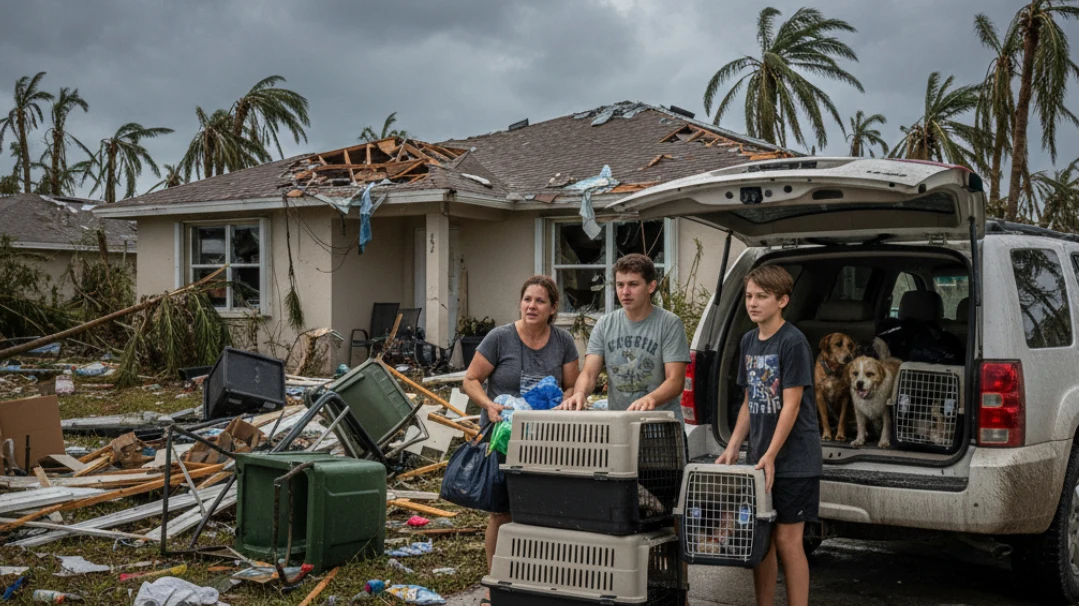
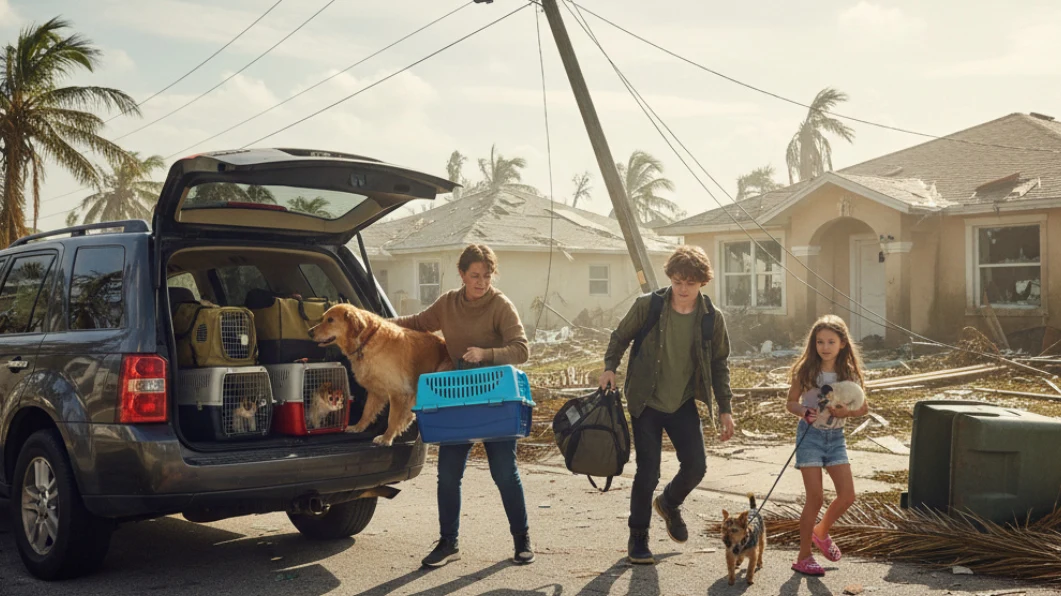
Florida family urgently loading pet carriers and dogs into SUV evacuating after hurricane damage
📡
Microchips & ID Tags — The Most Important Thing You Can Do
A chip and a tag are the difference between reuniting with your pet and never seeing them again

🚨 After Hurricane Katrina — 250,000 animals separated from their owners

Of the estimated 250,000 animals displaced by Hurricane Katrina, fewer than 15–20% were ever reunited with their owners. The primary reason was simple: no identification. No tags. No chips. No way for the shelter worker who found a frightened, wet dog on a rooftop to know who that dog belonged to or how to reach them. The animal rescue community calls this the single most preventable tragedy of the entire disaster — and it repeats itself after every major hurricane.

A microchip costs $25–$50 and takes 30 seconds to implant. An ID tag costs $5. Together they are the most effective pet recovery tool ever created. There is no excuse for any owned animal to not have both.

📡 Microchips — How They Work & Why They're Essential

What a microchip is — and what it isn't

A microchip is a tiny passive transponder — about the size of a grain of rice — that is injected under the skin between the shoulder blades. It requires no battery and never wears out. It stores a unique identification number that is read by a handheld scanner that any animal shelter, veterinary office, or animal control officer carries. When they scan a lost animal, that number comes up — and they look it up in a national database to find the owner's contact information.

This is exactly what happens at every shelter after a hurricane. Every animal that comes in gets scanned immediately. If that animal has a chip and the chip is registered with current contact information — they call you. If there is no chip — that animal goes into the system as unidentified and may be rehomed or euthanized before you ever find it.

A microchip is only as good as its registration. Getting your pet chipped and never registering the chip — or registering it with an old phone number — is almost as useless as no chip at all. The chip has a number. The number is worthless unless it is in a database linked to YOUR current contact information.

✅ What to do RIGHT NOW

1. Get every unChipped pet chipped at your next vet visit — or walk-in at any PetSmart or Petco clinic, usually $25–$45 with no appointment.

2. Register the chip at petmicrochiplookup.org — this searches ALL major registries.

3. Update your registration every time your phone number, address, or email changes.

4. Ask your vet to scan your pet's chip at every annual visit to confirm it is still reading and still in the right location.

⚠️ The registration problem — most chips are never registered

Industry estimates suggest that fewer than half of microchipped pets have their chip registered in a searchable national database. Vets implant the chip. The owner is given a registration card. The card sits on the counter. The registration never happens.

If you are not 100% certain your pet's chip is registered with your current phone number — do it today. Takes 5 minutes at petmicrochiplookup.org or the registry your vet uses.

🚨 The multiple registry problem

There is no single universal microchip database in the United States — there are multiple competing registries. A shelter may search one registry and not find your chip because it's registered in another. The solution: register in multiple registries. Always register with:

• AAHA Universal Pet Microchip Lookup (searches all major US registries)
• The registry card your vet provided
• Found Animals Registry (free)
• PetLink (if your chip brand uses it)

🏷️ Visible ID Tags — The First Line of Defense

Why tags matter even when you have a chip

A microchip requires a scanner to read. A collar tag requires eyes. When a neighbor finds a dog wandering in debris three blocks from your home, they are not going to a shelter — they are going to call the number on the tag. Tags are how most lost pets are reunited with their owners by members of the public. Chips are how shelters do it. You need both for maximum coverage.

After a hurricane, tags become even more critical because emergency responders, volunteers, and neighbors who find animals are not trained animal shelter workers — they won't think to scan for a chip. But anyone can read a phone number on a tag and make a call.

✅ What your tag MUST have

• Your cell phone number — not your home number which may be dead
• A second number — a family member outside the storm zone
• Your pet's name — helps strangers approach a frightened animal
• "REWARD" if you choose — increases the likelihood someone calls

Engrave directly on a metal tag — not a paper insert that soaks and becomes illegible in floodwater.

✅ Tag must be on a secure collar — right now

Check that your pet's collar fits properly — you should fit two fingers under it. A too-loose collar comes off when the animal panics and squirms. A too-tight collar is uncomfortable and can injure. Check fit monthly — animals change weight and puppies and kittens grow fast.

For cats: use a breakaway safety collar specifically — a standard collar on a cat can catch on branches and debris and strangle them. The breakaway releases under pressure and is the only safe collar style for cats.

⚠️ Tag alternatives — QR code tags

Modern QR code pet tags link to an online profile with your contact info, your pet's photo, vet records, and any medical needs. A smartphone scan immediately shows everything needed to contact you and care for your pet. Brands like PetHub and Tile offer these specifically for pet recovery. Battery-free QR tags are weatherproof and last years.

These complement — never replace — an engraved metal phone number tag. If the scanner has no internet, the QR code is useless. You need both.

✅ What shelter workers do the moment an animal comes in after a hurricane

Step 1: Scan for a microchip. Step 2: Read the collar tag. Step 3: Photograph the animal and post to the shelter's lost pet database and PetFinder. Step 4: Hold the animal for a mandatory waiting period before any adoption or rehoming. If your pet has a chip registered to your current number AND a tag with your cell number — shelter workers will have you called within minutes of your pet arriving. Without both, your pet enters a system that processes hundreds of animals and the odds of reunification drop dramatically with every passing day.

🛒 Identification Products for Every Pet

As an Amazon Associate we earn from qualifying purchases, at no extra cost to you.

⚠️ Where to register your chip — do all three

AAHA Universal Pet Microchip Lookuppetmicrochiplookup.org — searches ALL major US registries in one search
Found Animals Registryfoundanimals.org/microchip-registry — free, widely used by shelters
PetLinkpetlink.net — used by many vet clinics
HomeAgainhomeagain.com — one of the largest national registries

Register in all four. Update all four every time your phone number changes. Takes 15 minutes total. This is the most important 15 minutes you will ever spend for your pet.

🛒
Pet & Livestock Supplies — Get These Before Storm Season
Everything you need for your animals — from evacuation to post-storm recovery

⚠️ Buy these now — not when a storm is named

Pet supply stores sell out of carriers, portable food, and water supplies within hours of a named storm announcement. Amazon delivery stops in evacuation zones as storms approach. Everything on this list should be purchased, tested, and ready before June 1 every year. A carrier your pet has never been in is a carrier they'll fight going into during a crisis.

🥣 Food & Water — The Basics That Keep Your Animals Alive

💧
Collapsible Portable Water Bowl
Folds flat for evacuation, pops open for use. Silicone holds its shape when full. Essential for any pet during evacuation, shelter stays, or outdoor post-storm cleanup. Keep one in your go bag and one in your car.
Shop Amazon →
🥣
Collapsible Travel Food Bowl Set
Matching food and water bowl set that packs flat. Clip onto a bag or carrier for quick access. Dishwasher safe for decontamination after floodwater exposure environments.
Shop Amazon →
🚰
Gravity-Fed Water Dispenser (Large)
No electricity needed — gravity fills the bowl automatically. Keep filled before the storm. Works for dogs, cats, and small livestock. Holds 1–2 gallons for extended power outages.
Shop Amazon →
🗑️
Airtight Pet Food Storage Container
Keep a 7-day supply of dry food in a sealed waterproof container. Floodwater ruins open bags instantly. Airtight containers also keep food fresh during extended power outages without refrigeration.
Shop Amazon →
🦴
Emergency Dry Dog Food (7-day supply)
Store-brand dry food in sealed packaging keeps 12–18 months. Rotate your stock every season. Sudden diet changes stress already-anxious pets — use the same brand they normally eat.
Shop Amazon →
🐟
Emergency Dry Cat Food
7-day minimum supply in sealed waterproof packaging. Wet food pouches also work for short-term — they don't require refrigeration until opened. Keep their normal brand to reduce stress eating during the storm.
Shop Amazon →
🍶
Pet Water Bottle with Built-In Bowl
Squeeze bottle dispenses water into attached bowl — no separate bowl needed. Perfect for evacuation walks, shelter visits, and post-storm outdoor work with your dog. One-handed operation.
Shop Amazon →
🪣
Heavy-Duty Livestock Water Trough
Fill to capacity before the storm — automatic waterers fail without power. A full 100-gallon trough provides 2–3 days of water for horses. Polyethylene resists cracking in debris impacts.
Shop Amazon →

🏠 Shelter, Carriers & Transport — Getting Them to Safety

📦
Hard-Sided Dog Crate (Airline Approved)
Hard sides protect against crushing and flying debris inside a vehicle. Required by most emergency shelters. Introduce your pet to the crate before storm season — a familiar crate is a safe space, not a trap.
Shop Amazon →
🐱
Hard-Sided Cat Carrier
Soft carriers collapse under pressure from a panicked cat. Hard sides protect and contain. Line with a familiar blanket — your scent reduces stress. Keep the carrier out year-round so cats aren't afraid of it.
Shop Amazon →
🔲
Portable Dog Exercise Pen
Creates a safe contained area at a shelter or hotel when you can't watch your dog every second. Folds flat for transport. Sets up in minutes. Essential for multi-day evacuations with active dogs.
Shop Amazon →
🐴
Horse Trailer Ties & Cross Ties
Secure horses safely during evacuation transport. Cross ties keep horses centered and prevent turning during transit. Check all hardware before storm season — corrosion causes failures at the worst moments.
Shop Amazon →
🐓
Portable Chicken Tractor/Coop
Move poultry to safer ground before a storm. Portable coops with hardware cloth (not chicken wire) resist predator entry — wildlife displaced by storms becomes an immediate post-storm predator problem for chickens.
Shop Amazon →
🐇
Small Animal Carrier (Rabbit/Guinea Pig)
Ventilated hard carrier for rabbits, guinea pigs, and other small animals. Keeps them secure during evacuation. Small animals die quickly in heat — keep in air-conditioned vehicle only.
Shop Amazon →

🩹 Health, Safety & Comfort During & After the Storm

😌
Calming Treats for Dogs
Natural calming treats with melatonin and L-theanine reduce storm anxiety without sedation. Start 30 minutes before expected storm arrival. Discuss stronger options with your vet for severely storm-reactive dogs.
Shop Amazon →
🎽
Thundershirt Anxiety Wrap
Constant gentle pressure reduces anxiety in 80% of dogs and cats during storms. Drug-free, vet-recommended. Put it on 30 minutes before the storm starts — don't wait until your pet is already panicking.
Shop Amazon →
🧊
Pet Cooling Mat
Pressure-activated cooling — no electricity or refrigeration needed. Critical during power outages in Florida summer heat. Dogs and cats overheat faster than humans in the same conditions. Essential post-storm.
Shop Amazon →
🦺
Dog Life Jacket
For coastal areas at risk of storm surge — a life jacket keeps a dog afloat if flooding occurs suddenly. Handle on top allows you to pull them from water. Not all dogs are strong swimmers, especially in debris-filled water.
Shop Amazon →
🩹
Pet First Aid Kit
Gauze, bandage tape, non-stick pads, antiseptic wipes, tweezers, scissors, disposable gloves, emergency thermal blanket — sized for animals. Treat wounds immediately before vet access is available.
Shop Amazon →
🐾
Paw Balm / Wax Protector
Apply before walking through debris areas — wax creates a protective barrier on paw pads against debris cuts, chemical contamination, and hot pavement. Also soothes cracked pads from floodwater exposure.
Shop Amazon →
👟
Dog Protective Boots
Rubber boots protect paws from nails, glass, and floodwater contamination during cleanup. Introduce before the storm — a dog that's never worn boots won't cooperate during a crisis.
Shop Amazon →
💚
Waste Bags — Bulk Pack
Emergency shelters require waste cleanup. Sanitation at shelters and in debris areas is a public health concern — always clean up immediately. Keep a full bulk roll in your go bag at all times.
Shop Amazon →

🐄 Livestock Supplies — Large Animals Need Large Preparation

📋 Pet Records & Documentation — Required at Shelters

As an Amazon Associate we earn from qualifying purchases, at no extra cost to you.

✅ The complete pre-storm pet go bag — pack it now

Food & Water: 7-day food supply sealed airtight, collapsible bowls, portable water bottle, fresh water in sealed jugs
ID & Records: Vaccination records in waterproof pouch, USB backup, photo of you with your pet, microchip registration printout
Safety: Collar with ID tag, slip lead leash, muzzle (dogs), carrier, paw boots or wax, life jacket (coastal areas)
Comfort: Familiar blanket, favorite toy, Thundershirt, calming treats
Health: 2-week medication supply, pet first aid kit, flea/tick prevention, waste bags
Sanitation: Litter and litter box (cats), puppy pads, enzymatic cleaner

Store everything in a single waterproof bag or sealed bin. Know where it is. Grab it in under 5 minutes when the evacuation order comes.

⚠️
What Hurricane Katrina Taught Us
The law changed because of what happened to animals in 2005
Family with golden retrievers and pet carriers evacuating Florida home after hurricane, damaged roof visible

🚨 Hurricane Katrina 2005 — an estimated 250,000 animals died

Hundreds of thousands of pets were left behind when owners evacuated before Hurricane Katrina — many because evacuation shelters would not accept animals. Owners chose to stay with their pets rather than leave them, putting themselves in danger. An estimated 250,000 animals died. The images of animals stranded on rooftops and wading through floodwater became some of the most haunting of the entire disaster.

In response, Congress passed the Pets Evacuation and Transportation Standards (PETS) Act of 2006, which requires state and local emergency plans to accommodate household pets and service animals. Most coastal states and counties now have pet-friendly shelter options and livestock evacuation planning. Know your plan before the storm — not during it.

✅ The PETS Act — your legal protection

Under the PETS Act, FEMA is required to ensure that state and local emergency preparedness plans address the needs of individuals with pets and service animals. This means pet-friendly shelters must exist in your county's emergency plan. Call your county emergency management office before hurricane season and ask specifically: "Where are the pet-friendly emergency shelters in this county?" Get the address. Put it in your phone. Do it now.

🐾
Part 1 — Before the Storm: Pets
Preparation done now saves lives when the storm arrives

The most important pet preparations — do these before June 1

1

Microchip every pet — and keep the registration current

A microchip is the single most effective tool for reuniting lost pets with their owners after a hurricane. Collar tags fall off. Microchips don't. Every cat and dog should be microchipped. Then — and this is critical — register the chip with your current contact information at a national registry such as AAHA's PetMicrochipLookup.org and update it every year. An unregistered microchip helps no one. Microchipping costs $25–$50 at most vets and is a one-time procedure.

2

ID tags with your CELL phone number — not your home number

Engrave your cell phone number on your pet's collar tag — not your home phone, which may be dead or unavailable after the storm. Include a secondary contact who lives outside the hurricane zone. Update tags every time your phone number changes. Consider adding a QR code tag that links to your current contact information — several affordable services offer these specifically for pets.

3

Photograph your pet with YOU in the frame — today

A photo of you and your pet together is proof of ownership in disputes and reunification situations after a disaster. Take a clear photo of each pet with you in frame and save it to cloud storage. Also photograph any distinguishing markings, scars, or features. After Hurricane Irma, thousands of found pets could not be reunited with owners because there was no proof of ownership beyond memory.

4

Assemble a pet emergency kit — keep it with your go bag

7 days of food and water, medications with a 2-week supply minimum, vaccination records (required by pet-friendly shelters), a familiar blanket or toy to reduce stress, collar and leash, carrier or crate, waste bags, and a pet first aid kit. Store it in a waterproof bag or sealed bin. Know where it is and be able to grab it in under 5 minutes.

5

Vaccinate — especially for Leptospirosis

Dogs that contact floodwater after a hurricane are at high risk of Leptospirosis — a potentially fatal bacterial disease transmitted through water contaminated with animal urine. The Leptospirosis vaccine is not always included in standard vaccination packages — ask your vet specifically. Also ensure rabies, distemper, and bordetella are current — many pet-friendly shelters require proof of current vaccinations before accepting animals.

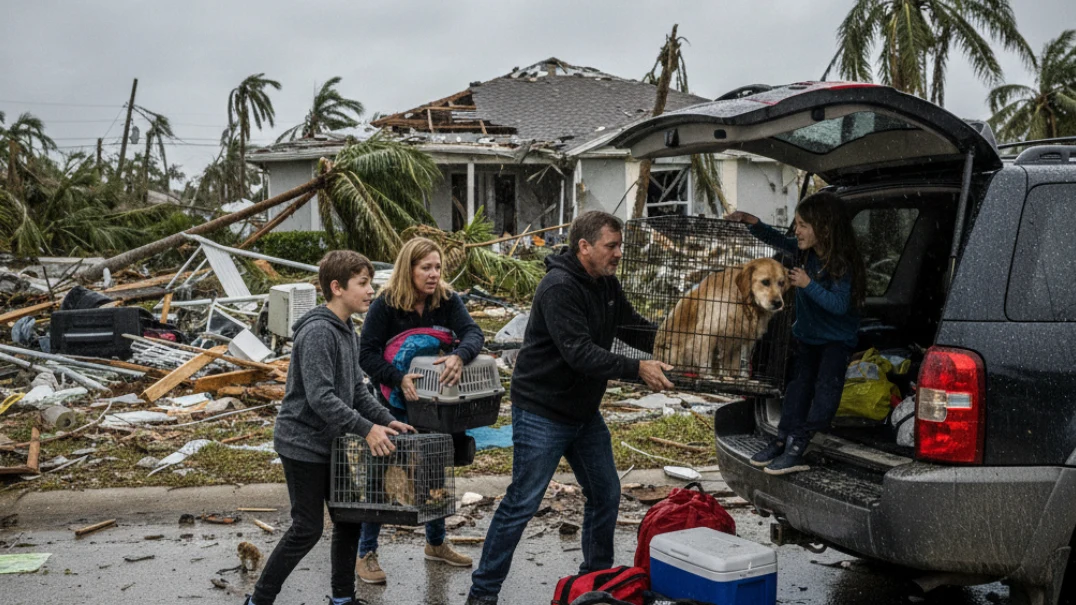
Family evacuating with multiple pet carriers, dogs, and supplies in hurricane-damaged Florida neighborhood
6

Know where you're going — with your pet — before the storm

Identify and contact at least three pet-friendly options before hurricane season: a pet-friendly hotel chain (La Quinta, Motel 6, and Kimpton properties have historically been most accommodating), a friend or family member outside the hurricane zone who will accept your animals, and your county's designated pet-friendly emergency shelter. Have all three options ready. Do not search for pet-friendly hotels during a mandatory evacuation — they fill within hours.

🐕 Pet-Specific Preparations by Animal Type

🐕
Dogs
  • Collar with cell number tag + microchip
  • Leash AND slip lead (panicked dogs slip collars)
  • Crate for transport and shelter
  • 7-day food and water supply
  • Anxiety medication from vet if storm-reactive
  • Leptospirosis vaccine current
  • Paw balm for post-storm debris walking
  • Designated potty area away from floodwater
🐈
Cats
  • Hard-sided carrier — soft carriers collapse in panicked cats
  • Breakaway collar with ID (cats need breakaway for safety)
  • Familiar blanket inside carrier to reduce stress
  • Litter box, litter, and scoop
  • 7-day food and water supply
  • Microchip — cats escape and are harder to catch
  • DO NOT leave cats to "fend for themselves" — they cannot
🦜
Birds & Small Pets
  • Birds are extremely sensitive to temperature changes — heat kills quickly
  • Cover cage with towel during storm — reduces panic and debris entry
  • Rabbits, guinea pigs, and hamsters cannot tolerate heat — plan AC backup
  • Fish tanks — unplug equipment, cover tank, cannot evacuate with fish easily
  • Reptiles — temperature-sensitive, need heat source during power outage
  • Keep in ventilated transport container during evacuation
🐴
Part 2 — Before the Storm: Livestock
Horses, cattle, pigs, goats, chickens — each with different needs

⚠️ The hardest decision — evacuate or shelter in place

For large livestock, evacuation is almost always safer than sheltering in place during a major hurricane. A horse trapped in a flooded stall cannot escape. Cattle and pigs in low-lying pastures can drown in storm surge. However, trailer availability, road conditions, and destination access make livestock evacuation complex. Make this plan before hurricane season — not when a storm is 48 hours out.

🐴
Horses

EVACUATE IF AT ALL POSSIBLE

  • Identify evacuation destination before season — fairgrounds, equine facilities, higher-ground properties
  • Halter and lead rope on every horse before storm arrives
  • Write your name and phone number in permanent marker on each horse's hoof — in case they escape
  • Do NOT confine in stalls if flooding is possible — they cannot escape
  • Fill water troughs to capacity — automatic waterers fail in power outages
  • Remove loose objects from paddocks — they become projectiles
  • If sheltering: the most solid structure, away from large trees
  • Contact your county agricultural extension office for local livestock evacuation resources
🐄
Cattle & Large Livestock

MOVE TO HIGHEST GROUND AVAILABLE

  • Move cattle to highest pasture on property before storm
  • Open gates to pastures on higher ground — allow movement
  • Do NOT leave in low-lying areas — storm surge and flooding kill cattle quickly
  • Identify your animals with ear tags or paint brands before storm
  • Ensure adequate hay and water stored at high-ground location
  • Remove anything a panicked animal could injure itself on
  • Contact your county agricultural emergency coordinator now — before season
🐓
Chickens & Poultry
  • Secure coop before storm — flying debris destroys standard coops
  • Lock chickens inside the coop before storm arrives — do not leave in the run
  • Reinforce coop doors and latches — wind forces open standard hardware
  • Provide extra food and water inside coop before storm
  • After the storm: check for injuries before letting birds out
  • Post-storm debris in run areas — check thoroughly before allowing access
  • Wet bedding grows dangerous mold quickly — replace immediately after flooding
🌀
Part 3 — During the Storm
Keep animals secure, calm, and indoors

🚫 Never let pets outside during the storm

Flying debris, extreme winds, and flooding kill pets instantly. Even a brief bathroom break in the early stages of a hurricane has killed dogs and cats. Use puppy pads indoors, a litter box, or a designated indoor area. Do not open exterior doors until the storm has completely passed and you have confirmed it is not the eye (which will be followed by the back wall of the storm).

🚫 Do not leave pets in vehicles during the storm

A vehicle is one of the most dangerous places to be during a hurricane — and one of the most dangerous for pets. Flying debris, flooding, and extreme heat make vehicles death traps. Pets must be inside a solid structure during the storm, not in a garage that could flood or a car that could be struck by debris.

⚠️ Animals sense the storm — prepare for panic behavior

Dogs and cats frequently exhibit severe anxiety during hurricanes — shaking, hiding, aggression, destructive behavior, or attempts to escape. Discuss anti-anxiety medications with your vet before hurricane season for storm-reactive pets. Secure all pets in crates or a designated room. A panicked dog that escapes an open door during a hurricane will not survive.

✅ Create a safe room for pets

Choose an interior room away from windows — bathroom, closet, or interior hallway. Put all pets in this room with water, food, their crate, and familiar items. Close the door. This protects them from both the storm and from escaping in the panic. Stay with them if possible — your presence reduces anxiety significantly.

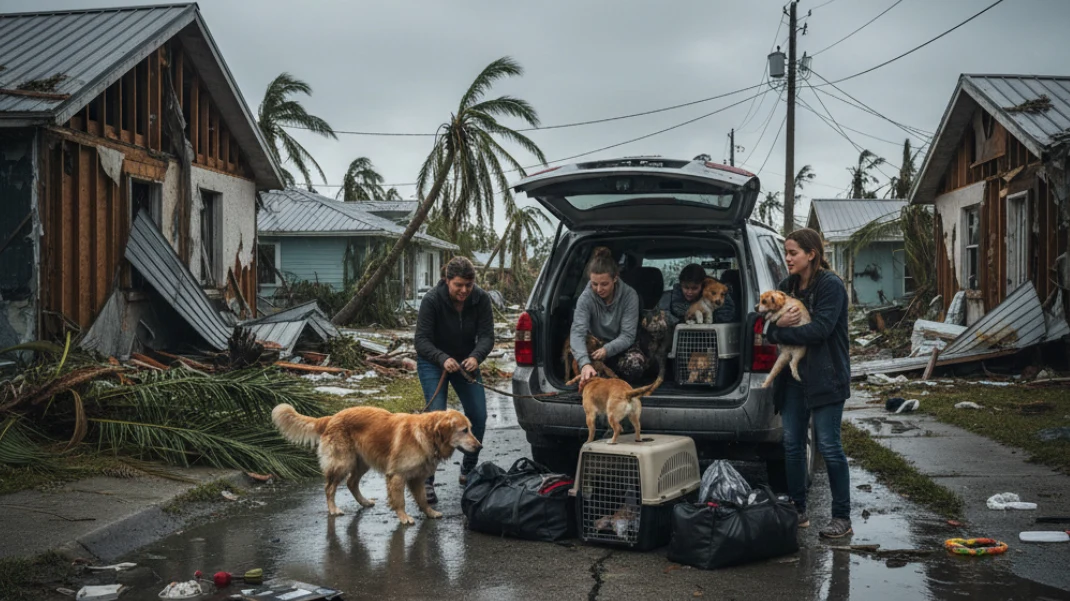
Volunteers helping rescue and evacuate multiple dogs from hurricane-damaged Florida neighborhood
⚠️
Part 4 — Post-Storm Hazards for Animals
The same dangers that threaten people threaten your animals — often more so

Animals face every human post-storm hazard — without the ability to protect themselves

Your dog doesn't know not to walk through floodwater. Your cat doesn't know the nail-filled debris in the yard will puncture its paw. Your horse doesn't know the downed power line in the paddock is live. Post-storm environments are as dangerous for animals as for people — and animals cannot communicate when they're hurt, infected, or in pain until the situation is often already serious. Be their first responder.

🚨 Nails, glass, and sharp debris — paw wounds

Roofing nails, broken glass, sheet metal fragments, and splintered wood are everywhere in post-hurricane debris. Dog and cat paws are unprotected — a single nail puncture to a paw that then contacts floodwater is a potential Leptospirosis exposure for the animal. Check paws after every outdoor trip. Look between the toes, at the paw pads, and at the webbing. Carry tweezers. Any puncture wound to the paw should be cleaned immediately and seen by a vet.

🚨 Floodwater — do not let pets drink it or wade in it

Floodwater contains Leptospirosis (potentially fatal to dogs), Vibrio bacteria, E. coli from sewage overflow, gasoline and motor oil, agricultural chemicals, and parasites. A dog drinking standing water after a hurricane can develop Leptospirosis and die within days without treatment. Keep fresh water available at all times. Prevent pets from accessing any standing water — on your property or in the neighborhood.

🚨 Downed power lines — electrocution

Dogs on leashes are often walked before the owner sees a downed line. Dogs off-leash will approach lines out of curiosity. A dog that contacts a live downed line in standing water can be electrocuted instantly — and the owner who rushes to help can be electrocuted next. Keep all pets on leash and under your direct control at all times post-storm. Never let pets into areas you have not personally cleared of power line hazards.

🚨 Displaced wildlife — snakes, fire ants, alligators

The same displaced wildlife that threatens people threatens pets — often more so because dogs investigate by smell and mouth, bringing them into direct contact with venomous snakes and fire ant mounds. A dog bitten by an Eastern Diamondback rattlesnake in a debris field may not survive without immediate antivenom. Keep dogs on a short leash in debris areas and prevent them from sniffing into piles. Fire ant mounds moved by flooding can be invisible — a small dog standing on a relocated mound can receive a life-threatening number of stings.

⚠️ Mold — respiratory risk for pets too

Dogs and cats exposed to mold spores in storm-damaged structures can develop respiratory illness, skin irritation, and in severe cases, neurological symptoms from mycotoxin exposure. Keep pets out of mold-affected areas entirely. If you notice your pet sneezing, coughing, or showing nasal discharge after spending time in a hurricane-damaged area — contact your vet and mention mold exposure specifically.

⚠️ Chemical hazards from flooded garages and vehicles

Flooded garages release gasoline, motor oil, antifreeze, pesticides, fertilizers, and cleaning chemicals into the water. Antifreeze (ethylene glycol) tastes sweet to dogs and cats and is lethal in small quantities — kidney failure within 24 hours. Do not allow pets anywhere near water that has been in contact with a flooded garage or vehicle. If you suspect antifreeze ingestion — this is a veterinary emergency. Get to a vet immediately.

🐕 Post-Storm Livestock Hazards

🚨 Fencing damage — escape and injury

Hurricane winds destroy fencing — electrified, barbed wire, and board fence alike. Inspect all fencing before releasing livestock from their storm shelter. A horse running into broken barbed wire in a panic causes severe lacerations that can be fatal. Walk the entire perimeter of every enclosure before releasing any animal post-storm. Temporary electric netting can create a safe holding area while permanent fencing is repaired.

🚨 Contaminated water sources — troughs and ponds

Ponds, streams, and water troughs contaminated by floodwater carry the same pathogens as all flood water — including Leptospirosis, E. coli, and toxic agricultural chemicals. Drain and scrub water troughs before refilling with clean water. Keep livestock away from any flooded ponds or streams until water quality has been confirmed by your county agricultural extension office.

⚠️ Debris in pastures — hoof and digestive injuries

Nails, wire, broken glass, and wood debris in pastures cause hoof punctures and nail-related laminitis in horses, and wire ingestion in cattle leads to hardware disease — a potentially fatal condition. Walk every pasture on foot before releasing livestock. Collect and dispose of all debris. This takes time — do not skip it.

⚠️ Stress-related illness after the storm

Horses and cattle commonly develop colic, founder, and respiratory illness in the days after a major storm due to stress, disrupted feeding schedules, and environmental changes. Monitor all livestock closely for the first week post-storm. Signs of colic in horses: pawing, looking at flanks, rolling, refusing to eat. Contact your large animal vet at the first sign — colic kills horses quickly.

🩺
Part 5 — Animal Wound Care After a Hurricane
Clean it immediately — then get to a vet as soon as possible

Field wound care for pets — the basics

1

Secure the animal first — pain causes aggression

Even the most gentle pet may bite or scratch when in pain. Muzzle a dog before handling wounds — use a slip leash, cloth strip, or commercial muzzle. Wrap a cat in a towel to control scratching. Approach slowly and speak calmly. Never restrain an animal by a limb that may be injured — you can worsen the injury and provoke a pain response.

2

Control bleeding with direct pressure

Apply a clean cloth or sterile gauze directly over the wound and hold firm pressure for 5–10 minutes without lifting. Lifting the cloth breaks the clot forming underneath. If blood soaks through, add more material on top — do not remove the original layer. Paw wounds on dogs bleed heavily even when minor — a soaked bandage does not mean the wound is more serious than it appears.

3

Flush with clean water

After bleeding is controlled, flush the wound thoroughly with clean water using a syringe or squeeze bottle. Remove any visible debris with tweezers. Apply veterinary antiseptic — chlorhexidine solution (diluted to light blue color) is the veterinary standard. Do not use hydrogen peroxide or full-strength iodine — both damage tissue.

4

Cover and prevent licking

Apply sterile gauze and bandage loosely — tight bandages cut circulation. An Elizabethan collar (cone) prevents the animal from licking the wound — licking introduces oral bacteria and significantly delays healing, often causing what was a minor wound to become infected. Keep covered and dry until you can reach a vet.

5

Tell the vet about floodwater exposure

Just as with human wounds — tell your vet specifically if the wound occurred in or near floodwater. This changes the treatment approach immediately. Leptospirosis prophylaxis, broader spectrum antibiotics, and different wound care protocols may all be indicated. This one detail can be the difference between a straightforward wound treatment and a missed diagnosis.

🛒 Pet Emergency & First Aid Supplies

As an Amazon Associate we earn from qualifying purchases, at no extra cost to you.
Frequently Asked Questions
Should I evacuate with my pets during a hurricane?
Yes — always. If you evacuate, your pets come with you. The PETS Act of 2006 requires state and local emergency plans to accommodate pets. Many shelters now accept pets in separate areas. Never leave pets behind — their survival rate in flooded structures is very low. Find pet-friendly shelters at petswelcome.com or call 211 before the storm.
What are the biggest dangers for pets after a hurricane?
Paw punctures from nails and debris, floodwater contaminated with Leptospirosis and Vibrio bacteria, downed power lines, displaced venomous snakes and fire ants, antifreeze from flooded garages (lethal in small doses), mold in affected structures, and toxic chemicals in standing water. Check paws after every outdoor trip. Prevent all access to standing water.
Can pets drink floodwater after a hurricane?
Never. Floodwater contains Leptospirosis (potentially fatal to dogs within days), Vibrio bacteria, E. coli from sewage, antifreeze, pesticides, and parasites. Keep fresh water available at all times. Prevent pets from accessing any standing water on your property or in the neighborhood. If you suspect your pet drank floodwater — contact a vet immediately and mention floodwater exposure specifically.
What should I do first if my dog or cat is injured after a hurricane?
Secure the animal with a muzzle or towel wrap — pain causes aggression in even gentle pets. Control bleeding with direct pressure. Flush the wound thoroughly with clean water. Apply diluted chlorhexidine antiseptic. Cover with sterile gauze. Apply a cone to prevent licking. Get to a vet as soon as possible and mention any floodwater exposure. Do not use hydrogen peroxide — it damages animal tissue.
Should I confine my horse in the stall during a hurricane?
Not if flooding is possible — a horse trapped in a flooded stall cannot escape and will drown. If storm surge or serious flooding is forecast, horses must be evacuated to higher ground. If only wind is the concern and flooding is not expected, the most solid structure on the property away from large trees is appropriate. Write your name and phone number in permanent marker on each horse's hoof in case they escape during the storm.

Protect Your Home — Protect Your Family

Hurricane shutters keep the storm out of your home — protecting your family, your pets, and everything inside. Get your free estimate today.

Free Shutter Estimate → Full Supply Checklist →