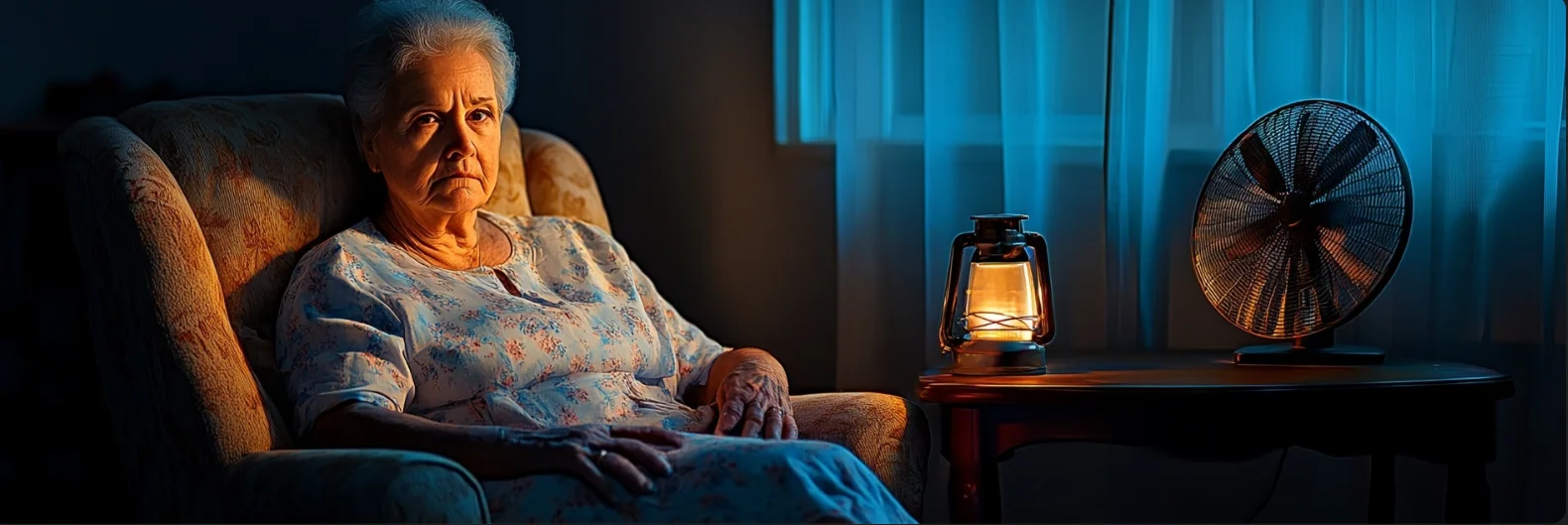
An extended Florida power outage is uncomfortable for healthy adults. For elderly family members — especially those with medical conditions, mobility challenges, or who live alone — it can become life-threatening within hours. Here is everything you need to know.
FEMA post-hurricane mortality data shows people over 65 account for more than half of all hurricane-related deaths — the majority occurring not during the storm itself but in the days and weeks after. Heat, medication disruption, limited mobility, and social isolation are the primary causes. In Florida's August heat, an elderly person without air conditioning can reach dangerous body core temperatures within hours of the power going out.
In every Florida neighborhood there is an elderly resident who lives alone and will not ask for help. They have survived 30 Florida summers and nine hurricanes and they do not want to be a burden. That independence is admirable. It can also be fatal during a two-week August outage with 95-degree heat and no air conditioning.
The most important thing Florida long-timers have learned: check on every elderly neighbor within the first 24 hours after a storm. Not a text. A knock on the door, in person. Bring ice. Offer to share a meal. The cost of that visit is 15 minutes of your time. The cost of not doing it has sometimes been much higher.

Older adults have a measurably reduced ability to thermoregulate. Their bodies are slower to detect rising core temperature and slower to respond through sweating. They commonly have reduced thirst sensation, which means they become dehydrated before they feel thirsty. Many medications taken by older adults — diuretics, antihistamines, beta-blockers, certain antidepressants and antipsychotics — further impair the body's heat response. A 75-year-old in a 95-degree house without AC is in genuine danger within hours, not days.
Florida counties open designated cooling centers — typically schools, libraries, and community centers with generator power — within hours of major storms. These are free and open to everyone. Bringing an elderly family member or neighbor is not an overreaction; it is appropriate care. Know your county's cooling center locations before hurricane season, not during it.
Battery-operated fans dramatically improve comfort even in high heat by accelerating evaporation from skin. Wet towels on the back of the neck, wrists, and forehead accelerate cooling further. These are not substitutes for air conditioning in extreme heat — they buy time. Use them while arranging cooling center access or generator power.
Because elderly people often do not feel thirsty when becoming dehydrated, fluids must be offered on a schedule rather than left to request. Offer water, electrolyte drinks, or juice every hour during hot weather. Keep a written log if necessary. Signs of dangerous dehydration in elderly adults: confusion, extreme fatigue, dark urine, dry mouth, rapid or weak heartbeat.
Identify the coolest room in the house — typically interior rooms, north-facing rooms, or rooms at floor level. Consolidate living there during peak heat hours. Draw all blinds and curtains to block radiant heat through glass. Close doors to unoccupied rooms to reduce the volume of air being heated by the house structure.
Before hurricane season, every family with elderly members should answer these questions: Which medications require refrigeration? What is the current supply level — will you have 30 days on hand if resupply is disrupted? Which medications absolutely cannot be missed, and what happens physiologically if they are? Insulin, heart medications, blood thinners, seizure medications, and psychiatric medications all require specific contingency planning that cannot be improvised during a crisis.
Insulin specifically can typically be kept at room temperature for 28–30 days (check your specific product's insert). However, in Florida summer heat, "room temperature" frequently exceeds safe limits. A small dedicated cooler opened only briefly twice daily, with a few cubes of ice replaced as needed, can maintain safe medication temperatures through a week-long outage.
Most major pharmacy chains open emergency medication distribution points after major storms. Contact your pharmacy chain and county health department within 24 hours of the storm for locations. Do not wait until medications run out to address this — the lines grow long fast.
Insulin · Nitroglycerin tablets · Most eye drops · Suppositories · Epi-pens and auto-injectors · Biologic medications and immunosuppressants · Some liquid antibiotics. If uncertain about any medication's heat tolerance, call the 24/7 pharmacist line on the bottle.
Elderly individuals living alone face acute social isolation during extended power outages. No television. No internet. Phone battery dying. Neighbors busy with their own families. What feels like a manageable inconvenience to a household of four can feel like abandonment to an 80-year-old whose primary social connections have all gone offline simultaneously.
Post-hurricane research consistently finds elevated rates of depression, anxiety, and measurable cognitive decline in elderly survivors who experienced social isolation. Regular human contact during extended outages is as medically significant as water and medication access.
Organize a neighborhood check-in schedule for elderly residents. Visit once in the morning and once in the afternoon. Bring ice, a meal, your presence. Sit for 20 minutes and have a real conversation. Play a hand of cards. These visits are not charity — they are the community infrastructure that has kept Florida neighborhoods functioning through storms for generations.
For elderly residents whose medical equipment requires electricity — oxygen concentrators, CPAP machines, feeding pumps, electric wheelchairs, stair lifts — a power outage is immediately a medical emergency planning situation. Contact your equipment supplier before hurricane season for battery backup options. Many oxygen concentrators have portable battery options. CPAP manufacturers sell battery backup units that provide 1–2 nights of operation.
If equipment cannot be backed up, this person should be evacuating before the storm or transferring to a medical shelter — most Florida counties maintain special needs shelters for residents who require electricity for medical devices. Pre-registration is required and opens before each storm season.