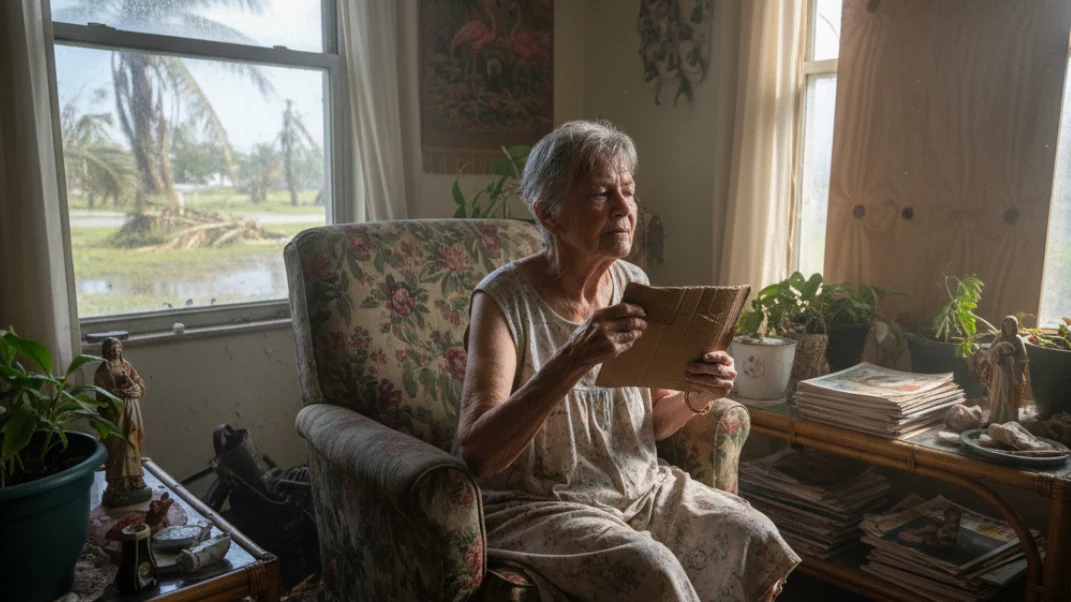
More people die in the days after a Florida hurricane from heat than from the storm itself — and the people they die are almost always older. Elderly bodies sweat less, feel thirst less, and many take medications that block the body's own cooling. This is how to make a hot powerless house survivable, what to actually buy, and the warning signs that mean it is time to leave for a cooling center.
The storm is gone, the sky is blue, and the news has moved on. Then the temperatures climb into the nineties with no AC, and over the next several days more people quietly die from heat in their own homes than died in the storm itself. The hardest-hit are almost always the same ones least equipped to feel it happening.
Older bodies handle heat differently in ways that compound. They sweat less, so they cool less. They feel thirst less, so they dehydrate before realizing it. Many take diuretics, beta blockers, and blood-pressure medications that interfere with the body's ability to cool itself or to know it is in trouble. Chronic heart disease and diabetes further reduce heat tolerance. A temperature that feels uncomfortable to a younger person can be a clinical emergency for someone older — and the person experiencing it often does not recognize the warning signs.
In Florida specifically, the danger window opens within hours of an outage and stays open for as long as power is out, often days. Plan for cooling the same way you would plan for water and food: assume you will need it, buy what works before the storm, and have a place to go if the house gets too hot.
If you have an elderly parent or neighbor in a separate home, set a fixed check-in schedule for every outage — in person, twice a day. People in heat distress often do not call for help themselves; someone has to come see them.
Heat exhaustion — the warning stage. Heavy sweating, weakness, cool/clammy skin, fast and weak pulse, nausea, headache, dizziness. Move the person to the coolest available place, have them lie down, apply cool wet cloths, sip water slowly. Should improve within 30 minutes. If it does not, treat as heat stroke.
Body temperature above 103°F. Hot dry skin (sweating may have stopped). Confusion or disorientation. Rapid strong pulse. Headache. Possible loss of consciousness. Heat stroke is a medical emergency. While waiting for EMS, move the person to the coolest place available, remove excess clothing, and cool aggressively — wet cloths or a cool (not ice-cold) bath, fans blowing on wet skin, ice packs at the neck, armpits, and groin. Do not give fluids if the person is confused or vomiting.
In older adults the progression from "fine" to heat stroke can be fast and quiet. If the indoor temperature is above 85°F and an older adult seems confused, unusually tired, or stops sweating, treat it as a medical emergency until proven otherwise.
A fan does two things: it moves air across the skin to evaporate sweat, and it moves cooler air around a hot room. Both work up to about 95°F; above that, fans alone become less effective and you need to add water or active cooling.
The right kind of fan for a hurricane is rechargeable, with a built-in lithium battery rated for 20+ hours on low speed. A USB-rechargeable table fan or clip-on fan runs all night on one charge and tops up from any portable power station, car USB, or solar panel. Skip the AC-only floor fans you cannot run; they are paperweights in an outage.
Buy more than one. One fan over the bed for sleep, one for the living chair during the day, one for the kitchen — and a small clip-on for the bathroom. They are cheap, they recharge fast, and the difference in comfort is enormous.
When you cannot cool the whole house, cool the person. The body sheds heat most efficiently through skin near large blood vessels — the neck, wrists, and inside of the elbows. A few low-cost items target exactly those spots:
Evaporative cooling towels. Wet, wring out, snap. The fabric releases moisture slowly and feels much colder than wet cloth. Drape around the neck and re-wet every 30–60 minutes.
Phase-change neck rings. Solidify when soaked in cool water — no freezer needed — and stay cool against the neck for an hour or two. Several brands are very popular; rotate two so one is always cooling.
Cooling vests with ice packs. The serious option for very hot homes. Insert frozen or refrigerator-temperature gel packs into a vest and wear it for 1–2 hours at a time. Pair with a battery fan and you can survive a 90°+ living room in real comfort.
Pair any of these with a fan blowing across wet skin and you can drop your effective body temperature by several degrees even in a hot room.
True portable air conditioners (the rolling 8,000–14,000 BTU units) draw 800–1500 watts and exhaust hot air out a window — they need a generator or a very large power station and a serious install. For a brief outage, that is not realistic for most households.
The realistic options for battery-only cooling:
Small "portable AC" / personal coolers (50–100W). These are evaporative coolers (swamp coolers) or thermoelectric units, not real ACs. They cool a small area around a chair or bed by a few degrees as long as humidity is not maxed out. Helpful, not a miracle.
Battery-friendly real AC (newer DC models). A handful of 5,000-BTU window-style units and small mini-split heads are now sold for off-grid use and can run from a 1500Wh+ portable power station for several hours. Expensive but effective.
Pragmatic truth: a $50 rechargeable fan plus a $20 cooling towel plus a $30 neck ring outperforms most "portable AC" you can run on battery alone, costs far less, and lasts indefinitely. Spend the AC budget on a bigger power station that runs a real window unit when a generator gets it going.
Some hot houses cannot be made safe with fans and towels alone. If the indoor temperature climbs above 85°F and is not coming down, or if there are any signs of heat illness, leave. Do not wait for it to get worse — that is when people get hurt.
Your options, in rough priority:
The basic kit is inexpensive and works. Buy before the season — the shelves empty fast when a storm is named.