Hurricane Waste Bags Spread Disease Across Entire Neighborhoods
E. coli. Leptospirosis. Norovirus. Hepatitis A. They don't stay in your bags — they reach your neighbors' children, their dogs, and the waterways your community uses. Here's what every coastal homeowner across all 13 states must know.
After every major hurricane, entire neighborhoods become temporary open-air waste management sites. The choices each household makes about how they handle waste bags directly affects the health of every family on the street — not just their own. This page covers the diseases, the transmission routes, and exactly what to do to protect your family and your neighbors.
8 symptoms, ER vs doctor guidance, daily decon checklist, health dept contacts for all 13 states. Print and post in your garage before hurricane season.
This Is Not Like COVID — You Are Not Waiting to Meet Someone Who Is Sick
"My husband kept saying 'we'll be careful, we'll wash our hands, we won't get too close to anyone sick.' He was thinking about it like COVID — like the danger was out there somewhere in another person. I had to explain to him that the danger is in every single bag at our curb. It's not in a stranger across the room. It's ten feet from our front door right now, in a bag we put there ourselves. That completely changed how seriously he took it."
— Cape Coral, FL homeowner · Post-Ian, 2022
☠️ With COVID, you were hoping not to encounter an infected person. With hurricane waste bags, the pathogen is guaranteed to be present — in your bags, in your neighbors' bags, in every bag on your street.
E. coli. Leptospirosis. Norovirus. Hepatitis A. These are not diseases you might encounter if you're unlucky. They are present in every bag of human waste sitting at every curb on your block right now. The question is not whether the pathogen is there. It is only whether it reaches your family.
With an airborne respiratory illness like COVID, the transmission chain requires you to be near an infected person who is shedding virus. You can avoid crowds. You can distance. The infected person has to find you.
Post-hurricane waste bag disease is the opposite. The pathogen has already found you. It is sitting at your curb. It is in your neighbor's bags ten feet from your property line. It is in the standing water running down your street from the pile down the block. It is on the pavement your children walk on. It is on every surface your dog sniffs on its leash. You do not have to go looking for it. You have to actively prevent it from reaching you — because it is already there, right now, in guaranteed concentration, waiting for a pathway into your household.
⚠️ There is no "avoiding" post-hurricane waste pathogens the way you avoid a sick person
You cannot stay away from the disease vector the way you stay away from someone who is coughing. The vector is your own curb. It is the street in front of your house. It is the storm drain your children's rainwater runoff goes into. The only protection is active barrier management — double-bagging, labeling, covering, keeping children and pets physically separated, washing hands every time, every day, without exception. There is no passive protection here. The bags are there. The pathogens are in them. The pathway to your family is the only variable you control.
"Our neighborhood had a post-Ian community meeting about debris pickup. Someone asked 'how worried should we actually be about disease?' A retired ER doctor in the neighborhood stood up and said something I've never forgotten: 'With COVID you were afraid of one infected person in a crowd of a thousand. With what's sitting at your curb right now, every single bag is infected. There is no uninfected bag. The question is only whether your kids touch it.' The room got very quiet."
— Bonita Springs, FL neighborhood meeting · Post-Ian, 2022
What this means practically
You cannot wait for symptoms to appear before taking precautions. By the time your child shows symptoms of E. coli or Leptospirosis, exposure already happened days ago. The window for prevention is before contact, not after.
Every hour the bags sit at the curb is another hour of exposure risk. Florida heat accelerates decomposition and gas production. A bag that was sealed on Day 1 is structurally weaker and more likely to fail on Day 10. The risk increases over time, not decreases.
Rain doesn't wash the danger away — it spreads it. Every rainstorm during the cleanup period carries waste bag runoff across your driveway, your sidewalk, your lawn, into your storm drain, and into your neighborhood's waterways. Rain is a transmission event, not a cleaning event.
Your neighbors' bags are your problem too. You didn't put the pathogens in your neighbor's bags, but their bags are 30 feet from your front door. Their bag failure is your family's exposure event. This is a neighborhood problem that requires a neighborhood conversation — before the storm, not after the bags are already at the curb.
The decontamination protocol is not optional caution — it is mandatory barrier management. Shoe removal outside. Clothes off at the door. Hand washing before contact with any family member. These aren't careful habits. They are the physical barriers between guaranteed pathogen presence and your household.
Share this with your neighbors before hurricane season:
The single sentence that changes how people think about this: "With COVID you were hoping not to run into someone who was sick. With hurricane waste bags, every bag on every curb is sick. The disease is already on your street." That one reframe is the difference between people treating this as a remote possibility and treating it as the guaranteed present-tense risk it actually is.
The Pathogens
8 Diseases That Spread From Improperly Handled Waste Bags
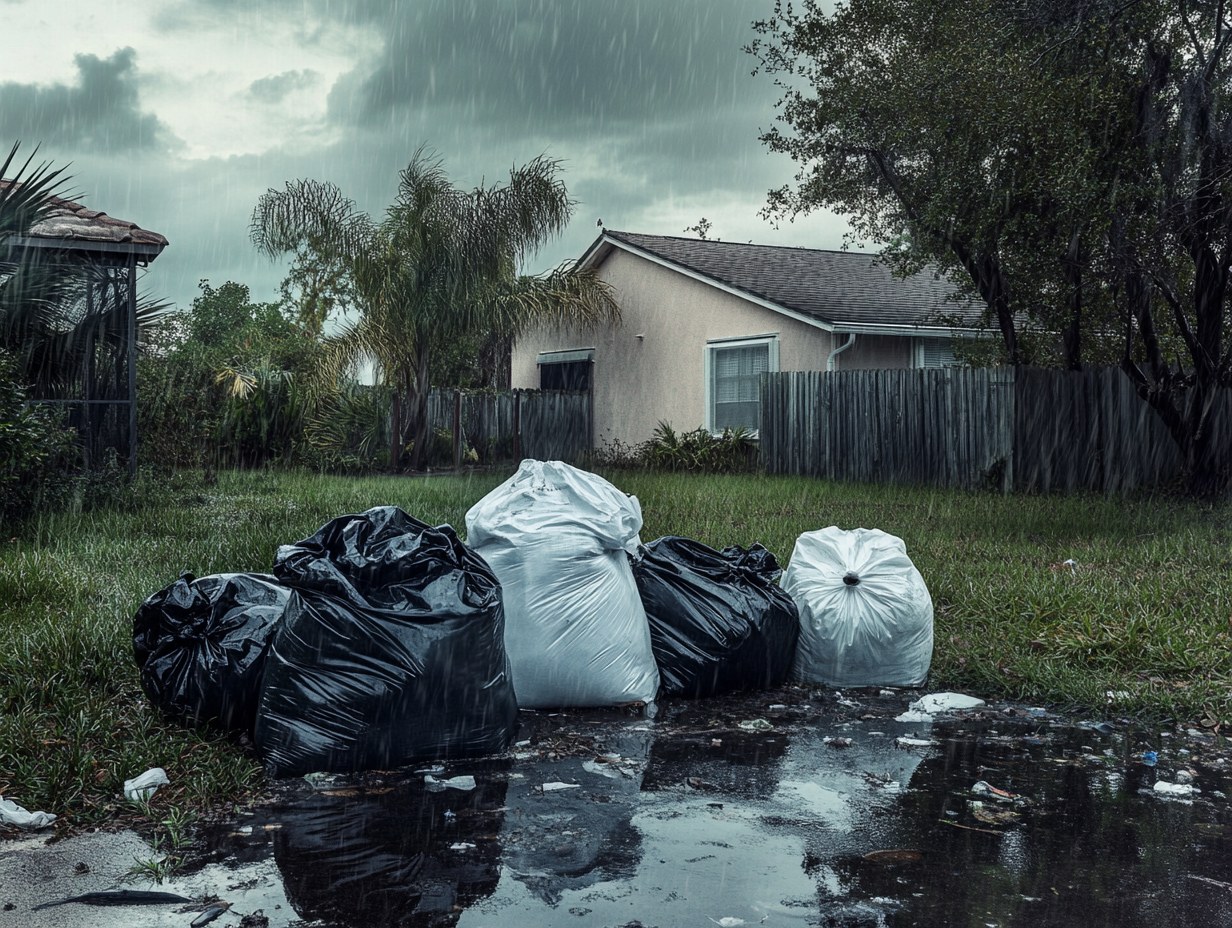
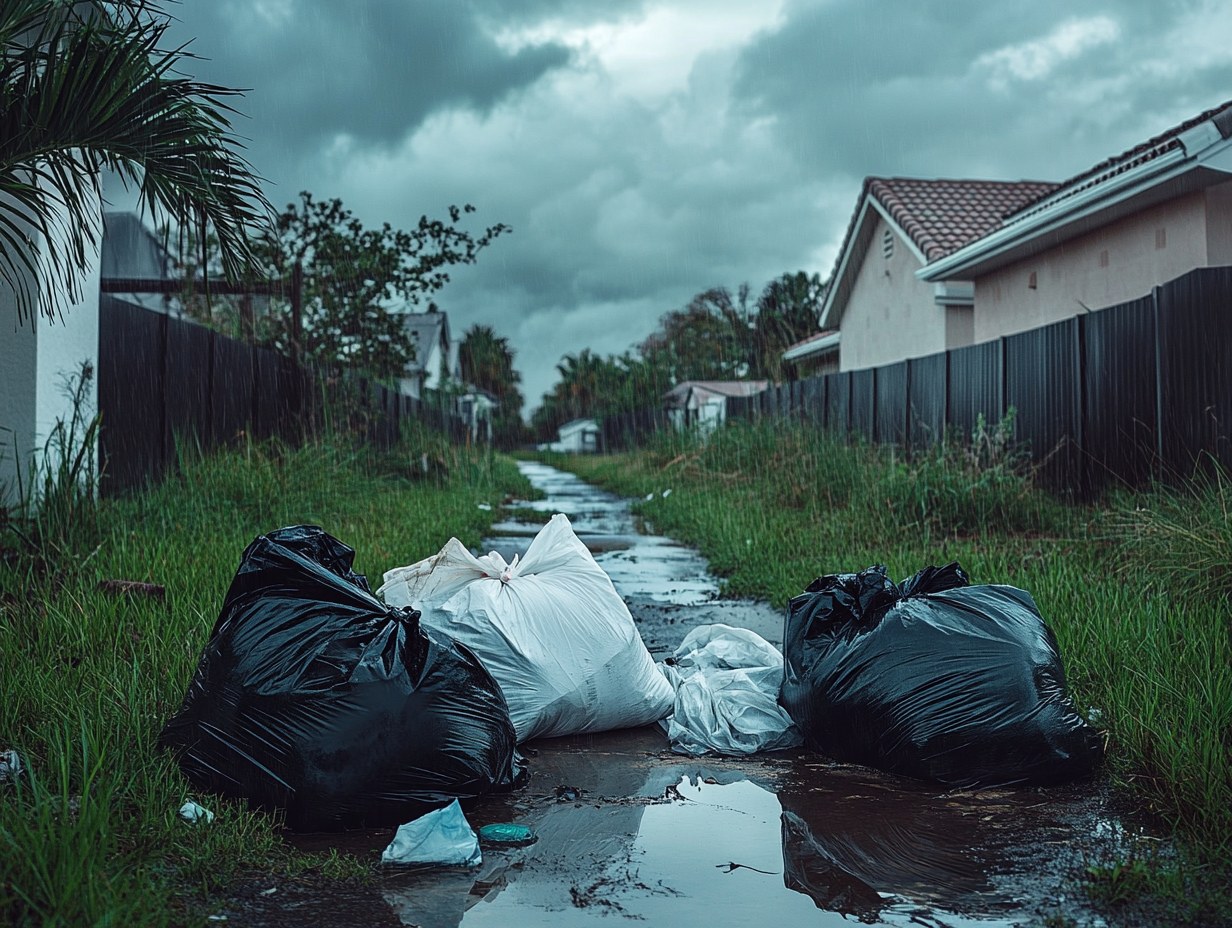
A typical post-hurricane street. Every bag is biologically contaminated. Children and pets should be kept off the street until pickup is complete.
"About two weeks after Ian, half our street came down with the same stomach bug simultaneously. Whole families sick at once. The county health department traced it to a failed waste bag that split open at the curb and washed into the storm drain during a rain shower. Kids had been playing near the drain. Nobody connected it until people started being hospitalized."
Floodwater contaminated with waste; direct contact; animal vectors tracking through neighborhoods
Anyone with skin cuts; all pets
Norovirus
Norovirus
Aerosolized particles from disturbed bags; surface contamination of play areas
Entire neighborhoods — extremely contagious
Hepatitis A
Hepatitis A virus
Fecal-oral; contaminated surfaces and water near improperly handled waste
Unvaccinated individuals; children
Salmonellosis
Salmonella
Flies, rats, dogs accessing bags → carry pathogens to kitchens and food prep areas
Children, elderly, immunocompromised
Cryptosporidiosis
Cryptosporidium
Contaminated runoff entering private wells or water sources
Private well users; anyone without treated water
Mold respiratory illness
Stachybotrys, Aspergillus
Improperly sealed mold bags releasing spores when rained on or disturbed
Asthma sufferers, children, elderly
Cholera (documented post-disaster)
Vibrio cholerae
Severely compromised infrastructure with widespread waste contamination of water
All — fatal without rapid treatment
☠️ The Florida Department of Health documents disease spikes in every affected county after every major hurricane
This is not theoretical. After Ian in Lee County, after Helene in Citrus and surrounding counties, after Idalia in the Big Bend region — the pattern is identical. Disease clusters emerge 10–21 days after landfall, tracing back to curb pile contamination events. The spike is preventable. The knowledge gap is the problem.
Properly labeled bags at the curb — and a dog being kept away. Both matter equally.
Transmission Routes
How Disease Gets From Your Curb to Your Neighbor's Children
"My neighbor is a retired gentleman who didn't understand that waste bags and kitchen trash bags are different hazards. He put everything in the same pile, unlabeled, single-bagged. His dog got into it within an hour. Sick for four days. His neighbor's kids played near the same pile. Two of them had stomach illness within a week. He had no idea he'd done anything wrong — nobody told him."
— Crystal River, FL · Post-Idalia, 2023
Animal vectors. Flies land on waste bags, then land on food in open kitchens nearby. Rats, raccoons, and opossums — displaced by floodwater into residential neighborhoods — investigate every bag and track pathogens on their feet and fur for blocks in every direction. Dogs that access waste bags carry contamination home on their paws into the living space.
Rainwater runoff. Florida receives heavy afternoon thunderstorms even between named storms. Rain hitting an improperly sealed or sun-degraded bag carries its contents across driveways, sidewalks, and streets into storm drains. Storm drains in all 13 coastal states we cover discharge to the same waterways communities use for fishing, swimming, and in some cases, drinking water supply.
Children near curb piles. Post-storm debris piles are magnets for curious children. A child who touches any surface near a waste bag and then touches their face has direct fecal-oral transmission exposure. The critical rule: keep ALL children away from ALL curb piles on the street — not just your own household's pile.
Bag degradation in sun. A contractor bag in direct sun for 8–14 days begins to crack and fail structurally. In areas where debris pickup is delayed 2–3 weeks — common after major storms in all 13 states we cover — bags placed at the curb on Day 1 are failing by the time crews arrive.
Mixing bag types. When waste bags are mixed into general debris piles, debris crews handle Category 3 biohazardous material without appropriate PPE. This spreads contamination across multiple properties and exposes workers who are already operating under extreme post-storm stress.
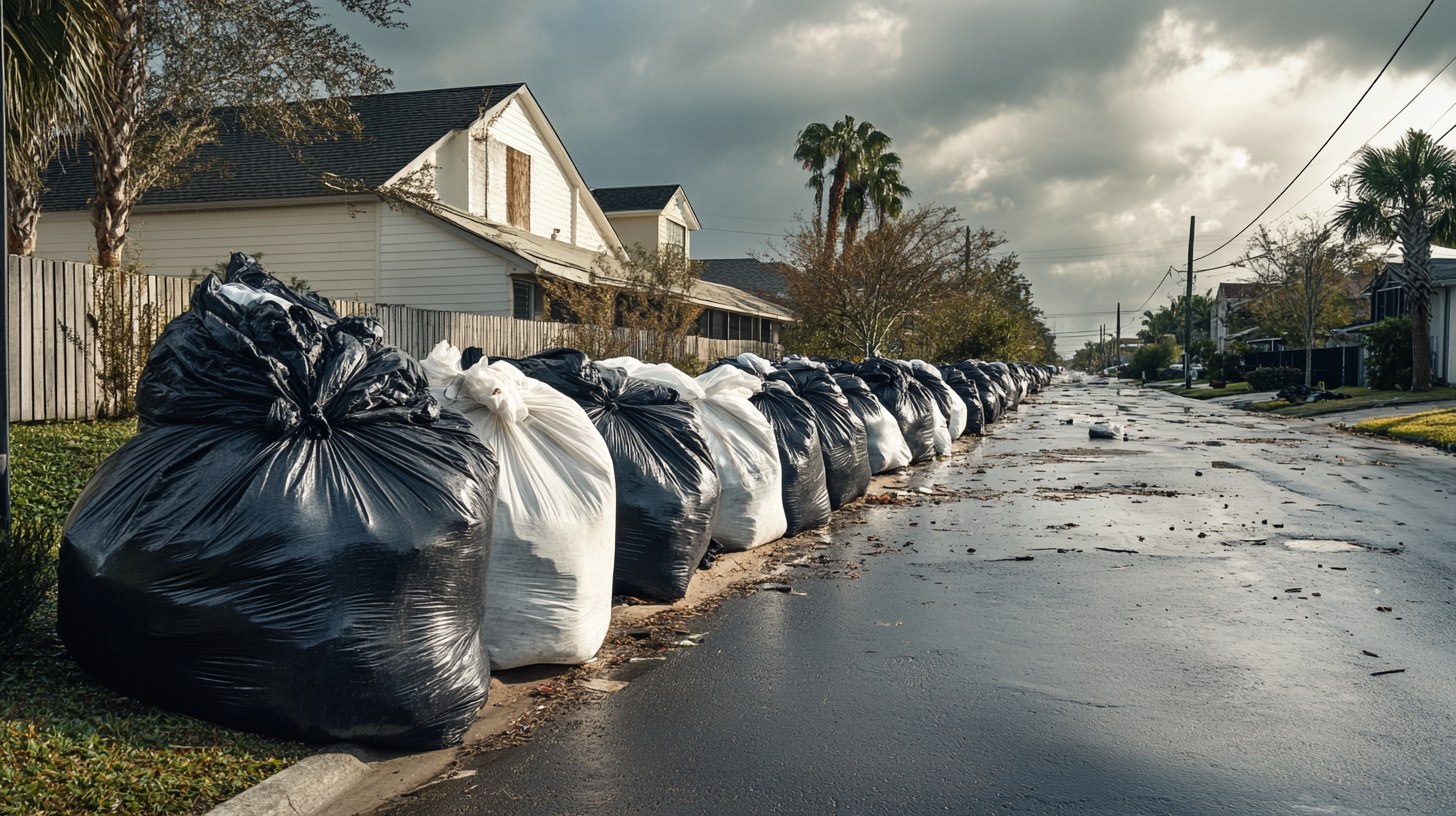
Every bag on every curb on this street is a potential disease transmission point for children, pets, and anyone who walks through rainwater runoff.
What to Do
The Complete Prevention Checklist
Every item below is actionable before the storm, during the outage, and at the curb. Share this list with every neighbor on your block.
Double-bag every waste bag without exception. A single failure in one layer is contained by the second. A single-layer waste bag that fails at the curb is a neighborhood disease event.
Label every bag on the outside — "☣️ HUMAN WASTE — BIOHAZARD — DO NOT OPEN" in large letters visible from 10 feet. Use a white paint marker or permanent marker on white duct tape applied to the bag surface.
Keep waste bags completely separate from all other debris. Never mix into a general pile. Stack separately, clearly labeled, 20+ feet from main debris pile.
Cover your waste bag pile with a tarp whenever rain is coming. Weight the tarp edges with dirt-filled contractor bags. This single step prevents the most common transmission event — rainwater runoff carrying bag contents into storm drains.
Keep ALL children away from ALL curb piles on your street — not just your own. Establish this rule with your children before the storm: no touching any bag, pile, or debris at any neighbor's curb. Ever.
Keep ALL dogs and cats leashed away from all curb piles. Your pets don't understand why a bag is dangerous. Your leash understands for them.
Check your bags every 48 hours while they're at the curb. Look for cracking, splitting, swelling, or color change. Any bag showing these signs must be double-bagged immediately before failure.
Wash hands after any contact with any bag, any debris pile, or any surface near the curb pile. 20 seconds with soap and water, followed by hand sanitizer.
Report obvious biohazard situations — failed bags spilling contents, animals in waste piles, improper mixing of waste and debris — to your local health department. Numbers for all 13 states are listed below.
Talk to your neighbors before the storm. One informed conversation per household multiplies protection across the entire block.
The 5-minute neighbor conversation that prevents disease outbreaks:
You don't need to be an expert. Share this page. Tell your immediate neighbors: double-bag waste, label it BIOHAZARD, keep it separate, cover it when rain is coming, and keep kids and dogs away from all curb piles. Five minutes. Dozens of families safer.
That child on the bicycle in the background is why this conversation happens before the storm — not after.
Dogs face direct Leptospirosis exposure from waste bag contact and standing water. Keep all pets away from curb debris piles.
Highest Risk
Children and Pets — Why They're Most Vulnerable
"Our four-year-old was playing in the front yard three days after Helene while we were clearing the backyard. She wandered over to the neighbor's debris pile and was touching the bags before we got to her. We spent two days terrified, watching her for symptoms. She was fine. But we didn't sleep. Every parent on a block with curb piles needs to have the conversation with their kids and establish a hard rule."
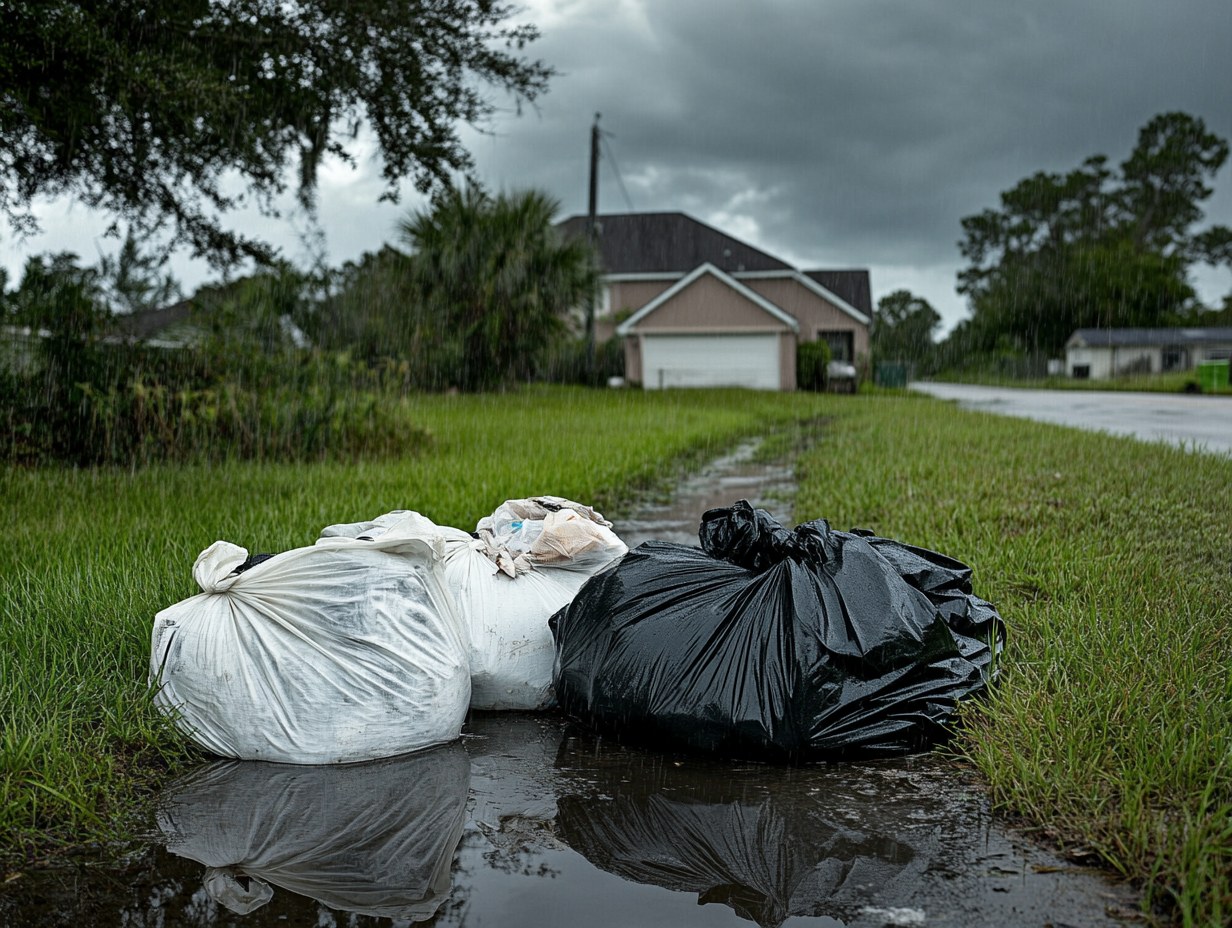
Rain runoff from waste bags reaches drains, yards, and standing water within hours — expanding the contamination zone beyond your curb.
— Lecanto, FL parent · Post-Helene, 2024
Children under 5 are at highest risk for E. coli kidney failure, severe Norovirus dehydration, and Leptospirosis. Their immune systems are still developing, their hand-to-mouth behavior is constant, and they are at floor level where contamination is highest concentration.
Children ages 5–12 explore independently and often approach debris piles out of curiosity. A direct conversation before the storm — "no touching any bags or piles anywhere on our street, not even at neighbors we know" — is the intervention.
Dogs are attracted by smell to waste bags and will chew through them if given access. E. coli, Salmonella, Leptospirosis, and Campylobacter are the primary veterinary risks. Any dog that accesses a waste bag should be seen by a vet within 24 hours even if they appear fine.
Cats are at risk from bags left on the ground — they climb inside large open bags to hide and can suffocate. They also track contamination indoors on their paws after walking through any contaminated area.
Elderly household members are at elevated risk for severe outcomes from all these pathogens. Norovirus dehydration that a healthy adult recovers from in 48 hours can require hospitalization in someone over 75.
⚠️ If a child or pet contacts waste bag contents
For children: wash hands and any contacted skin immediately with soap and water for 20+ seconds. Contact your pediatrician within 24 hours and report the exposure — they may advise monitoring for specific symptoms. For pets: contact your vet immediately. Document what they were exposed to. Leptospirosis symptoms in dogs may not appear for 4–12 days after exposure but treatment is most effective when started early.
All 13 States
Health Department Contacts — Every State We Cover
Report biohazard situations, get post-disaster health guidance, and find local resources after any major storm.
🌴 Florida
Florida Department of Health: 850-245-4444
Citrus County Health Dept: 352-527-0068
Post-disaster reporting: floridahealth.gov
Private well testing: Citrus County Water & Sewer 352-527-7880
The single most effective public health intervention after a hurricane is not a government program — it's informed neighbors talking to each other before the storm. One conversation per block, before the event, prevents the disease cluster that would otherwise emerge 2–3 weeks later.
You don't need to be an expert. You need five minutes and these five points:
Double-bag all waste. Two bags minimum. No exceptions.
Label it BIOHAZARD. Big letters. Visible from the street.
Keep it separate. Waste bags in their own pile, away from general debris.
Cover it when rain comes. A tarp over the waste pile stops the most common transmission event.
Keep kids and dogs away from all curb piles. All of them. Not just yours.
Share this page:
The URL for this page is hurricaneshuttercalc.com/hurricane-waste-disease-prevention.html — easy to text, easy to share in a neighborhood group chat. If one person on your block shares this page before hurricane season, it reaches every household automatically. That's how outbreaks get prevented.
E. coli (can cause kidney failure in children), Leptospirosis (liver and kidney failure — spreads through contaminated water and animal urine), Norovirus (violent vomiting and diarrhea — spreads entire neighborhoods rapidly), Hepatitis A, Salmonella, Cryptosporidiosis, and mold-related respiratory illness. The Florida Department of Health documents disease spikes in every affected county after every major hurricane.
How do I protect my neighbors from my waste bags?
Double-bag every waste bag. Label clearly: HUMAN WASTE — BIOHAZARD — DO NOT OPEN. Keep separate from general debris. Cover pile with tarp when rain is coming. Keep all children and dogs away from all curb piles on your street. Talk to immediate neighbors before the storm. Report biohazard situations to your state health department using the contacts on this page.
Can rainwater from curb piles make people sick?
Yes. Rain hitting improperly sealed bags carries contents across sidewalks into storm drains. In all 13 coastal states we cover, storm drains discharge to waterways used for recreation and sometimes water supply. Cover your waste bag portion of the curb pile with a tarp weighted at the edges. This is most critical in the 72 hours immediately after a storm when heavy follow-up rain is common.
Who do I call if I see an obvious biohazard situation at a neighbor's curb?
Contact your state or county health department using the numbers listed on this page. For Florida, that's the county health department — Citrus County at 352-527-0068. For immediate emergencies involving obvious contamination of a water source or children's play areas, call 911. Don't wait — the earlier a contamination event is reported, the faster it can be contained.
Do these disease risks apply to all 13 states you cover?
Yes — all 13 coastal states face the same risks after major storms. Leptospirosis is present in the soil and water of every coastal state. E. coli and Norovirus transmission from waste is independent of geography. The specific strains and local environmental factors vary, but the core prevention steps — double-bag, label, cover, separate, keep kids and pets away — are identical in Florida, Texas, New York, Massachusetts, and every state in between.
General Information Disclaimer: Content on this page is provided for general educational purposes only and is not a substitute for advice from licensed professionals or official emergency management authorities. In any emergency, follow directives from your local emergency management officials and the NOAA National Hurricane Center. HurricaneShutterCalc.com and Franklyns Bay LLC assume no liability for decisions made based on information on this site. Full disclaimer →
,sub=document.getElementById('cd-sub');if(!el)return;var now=new Date(),y=now.getFullYear();var s=new Date(y,5,1),e=new Date(y,10,30,23,59,59);function d(t){return Math.max(0,Math.ceil((t-now)/86400000));}if(now>=s&&now<=e){var n=d(e);el.textContent='Hurricane season ends in '+n+' day'+(n===1?'':'s');if(sub)sub.textContent='don\u2019t wait \u2014 protect your Florida home';}else{var ns=now>e?new Date(y+1,5,1):s;var n2=d(ns);el.textContent='Hurricane season begins in '+n2+' day'+(n2===1?'':'s');if(sub)sub.textContent='get your Florida home ready now';}})();
function toggleMenu(){var m=document.getElementById('mobile-menu'),h=document.getElementById('hamburger');var o=m.classList.contains('open');m.classList.toggle('open',!o);h.classList.toggle('open',!o);}
var btn=document.getElementById('btt');
window.addEventListener('scroll',function(){btn.style.display=window.scrollY>600?'flex':'none';},{passive:true});
btn.addEventListener('click',function(e){e.preventDefault();window.scrollTo({top:0,behavior:'smooth'});});