Hurricane Bleach and Disinfection Guide — Exact Ratios for Every Surface
After a hurricane, improper bleach use kills people. Too weak and pathogens survive. Too strong and you create toxic fumes. Here are the exact ratios that actually work.
Bleach — sodium hypochlorite — is a broad-spectrum oxidizing disinfectant that kills bacteria, most viruses, and surface mold by destroying cell membranes and proteins. After a hurricane, it's your most practical and effective tool for non-porous surface disinfection, emergency water treatment, and tool decontamination.
Bleach Dilution Ratios — The Numbers That Matter
The effectiveness of bleach depends entirely on concentration. Too weak and it doesn't kill pathogens. Too strong and it damages surfaces, produces dangerous fumes, and isn't more effective than a properly diluted solution.
All ratios below use regular unscented household bleach at 5.25–8.25% sodium hypochlorite (standard Clorox or store-brand). Concentrated bleach (8.25%+) requires less volume. Splashless and scented bleach are NOT suitable for disinfection — additives interfere with efficacy.
Use Case
Ratio
Per Gallon
Kills
Contact Time
General surface disinfection (floors, walls, counters)
1:16
1 cup bleach
E. coli, Salmonella, Leptospira, most bacteria
10 min
Hepatitis A and Norovirus on surfaces
1:12
1⅓ cups bleach
Hepatitis A, Norovirus (requires higher concentration)
10–15 min
Tool and equipment decontamination
1:10
1½ cups bleach
All above + broad spectrum
10 min
Emergency water treatment (clear water)
8 drops per gallon
8 drops (about ⅛ tsp)
Most bacteria and some viruses
30 min before drinking
Emergency water treatment (cloudy water)
16 drops per gallon
16 drops (about ¼ tsp)
Most bacteria and some viruses
30 min before drinking
Boot and shoe decontamination
1:16
1 cup bleach
E. coli, Leptospira, general contamination
1–2 min immersion or spray + wipe
Always measure — eyeballing bleach ratios leads to under-concentration that doesn't kill pathogens, or over-concentration that damages surfaces and creates fumes.
⚠️ Never mix bleach with these
Bleach + ammonia = chloramine gases (toxic). Bleach + vinegar = chlorine gas (toxic). Bleach + rubbing alcohol = chloroform and other toxic compounds. Never mix bleach with any other cleaner, regardless of what the label says. Use bleach alone, diluted in water only.
💡 Bleach shelf life matters
Bleach degrades over time, especially after opening. Fresh bleach from a sealed bottle is approximately 5.25–8.25% sodium hypochlorite. Bleach stored for more than 6 months at room temperature may have lost 20–50% of its effectiveness. After a hurricane, buy fresh bleach for disinfection work — don't rely on the bottle that's been under the sink for a year.
Bleach does not penetrate drywall, wood studs, carpet padding, or insulation. Surface application of bleach on these materials kills mold on the very surface only — the mold roots (hyphae) remain alive inside the material and regrow within days. The only correct approach for mold-contaminated porous materials is physical removal and disposal.
Tools, shovels, and equipment
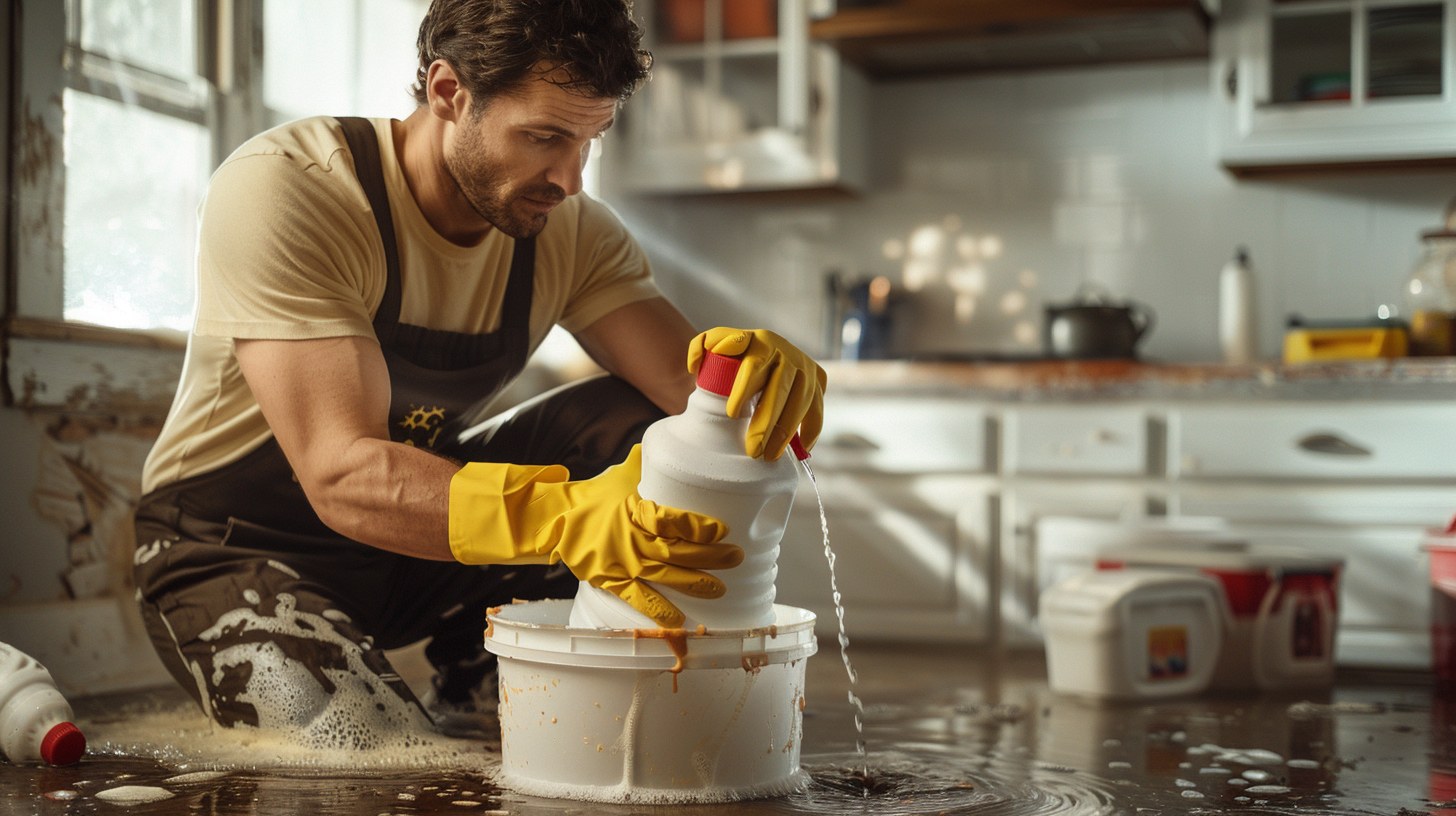
Tools that contacted flood-contaminated material — shovels, rakes, wheelbarrows, crowbars — need decontamination before storage and before bringing indoors. Use 1:10 bleach solution, immerse or spray thoroughly, leave for 10 minutes, rinse with clean water, and dry completely to prevent rust.
Boots and work shoes
The most important single decontamination step you can take is removing and disinfecting boots before entering your home. See the shoe rule guide for the full protocol. For bleach cleaning: spray or dip in 1:16 solution, scrub soles, leave for 2 minutes, rinse.
"After Helene I was using the wrong bleach ratio for the first week — I was using cleaning bleach, the scented kind, which apparently doesn't have the same disinfecting concentration. Didn't realize until a neighbor who's a nurse pointed it out. Switched to regular unscented and actually read the label this time. The disinfection concentration of cleaning-grade bleach is not the same thing."
— Homeowner, Buncombe County NC, post-Helene (2024)
Bleach and Mold — What It Can and Can't Do
This is the most misunderstood bleach application in hurricane cleanup. Bleach marketing contributes to the confusion.
Surface Type
Bleach Effective?
Correct Action
Tile grout (surface mold)
✅ Yes
1:16 solution, 10 min contact, scrub, rinse
Bathtub / shower (surface mold)
✅ Yes
1:16 solution, 10 min contact, scrub, rinse
Sealed concrete (surface mold)
✅ Yes
1:16 solution, 10 min contact, scrub, rinse
Drywall
❌ No
Remove and dispose if mold-contaminated
Wood studs
❌ No (surface only)
Dry completely within 48 hrs or remove
Carpet
❌ No
Remove and dispose after any flooding
Insulation
❌ No
Always remove and dispose after flood contact
Ceiling tiles
❌ No
Remove and dispose
The EPA guideline: mold areas smaller than 10 square feet (roughly 3 feet × 3 feet) can be handled by a homeowner with proper protection. Larger areas — and any area where mold has penetrated structural materials — require professional remediation.
If you have no access to bottled water and need to treat water from a potentially contaminated source, bleach is the available emergency option. Use it correctly.
⚠️ Bleach treats biological contamination only
Bleach does not remove petrochemicals, heavy metals, agricultural runoff, or other chemical contamination common in hurricane flood water. If your water source is flood water — not just potentially contaminated tap water — bleach treatment does not make it safe to drink. Use it only as an absolute last resort when no bottled water is available.
Emergency water treatment protocol
1Filter first — Pour water through several layers of clean cloth to remove visible particles. Bleach cannot effectively penetrate suspended particles.
2Add bleach — 8 drops per gallon for clear water, 16 drops per gallon for cloudy water. Use a dropper or syringe to measure accurately. Use only regular unscented bleach (5.25–8.25%).
3Stir and wait 30 minutes — The water should have a slight chlorine smell. If it doesn't, repeat the dose and wait another 15 minutes.
4Drink only if no other option exists — Boiling is more reliable if you have fuel. A ceramic or activated carbon filter is safer for chemical contamination. Bleach treatment is the option of last resort.
Bleach and Your Skin — What's Safe and What Isn't
A common question: can you use diluted bleach to disinfect your hands? The answer is nuanced.
Brief skin contact during cleanup
Incidental skin contact with diluted bleach solutions (1:16 or weaker) during cleanup is generally safe for intact skin. Rinse with water promptly. Prolonged skin contact causes irritation and drying.
What you should NOT do
Do not use bleach as hand sanitizer — it damages skin integrity and repeated use creates micro-cracks that actually increase infection risk
Do not use bleach to wash around open wounds or cuts — use clean water, hydrogen peroxide, or wound-specific antiseptic
Do not spray bleach without eye protection — splash risk is real, and bleach in eyes causes serious injury
Hand washing after cleanup
The correct protocol is soap and water for 20 seconds — not bleach, not hand sanitizer alone. Soap physically removes pathogens and debris. Hand sanitizer kills some bacteria but does not physically remove soil and organic matter. After removing gloves, wash hands with soap and water before anything else — before touching your face, your phone, your water bottle.
"I was doing cleanup after Ian and using diluted bleach water as a hand rinse between tasks — thought I was being safe. By day three my hands were cracked and bleeding in multiple places from the constant bleach exposure. My doctor told me the skin cracking was actually creating entry points for exactly the bacteria I was trying to avoid. Switched to a proper hand washing station and heavier gloves and the problem resolved."
— Homeowner, Cape Coral FL, post-Ian (2022)
Common Bleach Mistakes During Hurricane Cleanup
Mistake
Why It Fails
What to Do Instead
Using scented or "splashless" bleach
Additives reduce disinfecting efficacy; not EPA-registered for disinfection
Regular unscented bleach only (Clorox Regular, store-brand regular)
Using old bleach from under the sink
Bleach degrades — 6-month-old bleach may be 50% weaker
Buy fresh bleach for post-storm disinfection
Not pre-cleaning surfaces before bleaching
Bleach cannot penetrate organic matter — kills surface layer only
Remove all visible debris, rinse with water, then apply bleach solution
Wiping off bleach immediately
Contact time is required — 10 minutes minimum for most pathogens
Apply and leave wet for 10 full minutes, then rinse
Bleaching drywall and wood to "kill mold"
Does not penetrate porous materials — mold roots survive and regrow
Remove and dispose of mold-contaminated porous materials
Mixing bleach with other cleaners
Creates toxic chloramine or chlorine gas
Use bleach alone, diluted only in water
No eye protection during application
Splash risk — bleach causes serious eye injury
Safety glasses minimum; face shield for spray application
☣️ Post-hurricane waste disease risk
Every contractor waste bag on your street after a hurricane contains E. coli, Leptospira, Norovirus, and Hepatitis A. Bleach is your primary tool against these pathogens on hard surfaces — but your gloves, decon protocol, and shoe removal are what prevent them from entering your home in the first place. See the full hurricane disease prevention guide →
Frequently Asked Questions
What bleach ratio kills E. coli and bacteria after a hurricane?
1 cup of regular unscented bleach per gallon of water (1:16 ratio) creates a 1,000–5,000 ppm solution that kills E. coli, Salmonella, Leptospira, and most bacteria within 10 minutes of contact on hard non-porous surfaces. Pre-clean surfaces before applying.
Can I use bleach to make flood water safe to drink?
Only as an emergency last resort. 8 drops of regular unscented bleach per gallon of clear water, stir, wait 30 minutes. Bleach does not remove chemical contamination (petrochemicals, heavy metals) common in flood water — it only addresses biological contamination. Use bottled water whenever possible.
Does bleach kill mold after a hurricane?
Bleach kills surface mold on non-porous surfaces (tile, tubs, sealed concrete). It does not penetrate porous materials like drywall, wood studs, or insulation — mold roots survive and regrow. Remove and dispose of mold-contaminated porous materials; don't try to bleach them out.
What type of bleach should I buy for hurricane disinfection?
Regular unscented household bleach at 5.25–8.25% sodium hypochlorite. Not scented bleach. Not "splashless" bleach. Not "cleaning" bleach. Read the label — the active ingredient must be sodium hypochlorite and it must be EPA-registered as a disinfectant. Buy fresh — bleach older than 6 months may be significantly weaker.
How long does bleach solution last once mixed?
Diluted bleach solution degrades quickly — effective for approximately 24 hours at room temperature. Mix fresh solution each day of cleanup work. Don't store diluted bleach in spray bottles for more than a day. Undiluted bleach in a sealed bottle is stable for about 1 year.
Bleach vs Other Disinfectants — What Each One Actually Does
Bleach is the CDC's first recommendation for post-hurricane disinfection, but it isn't the right tool for every surface or situation. Here's how it compares to the alternatives you'll find at the hardware store:
Disinfectant
Kills Bacteria
Kills Mold
Safe on Wood
Cost
Household bleach (diluted)
✓ Yes
◑ Surface only
✗ No
Very low
Quaternary ammonium (Lysol)
✓ Yes
◑ Limited
✓ Yes
Moderate
Hydrogen peroxide (3%)
✓ Yes
✓ Yes
◑ With care
Low
White vinegar
◑ Some strains
◑ Some species
✓ Yes
Very low
Professional antimicrobial spray
✓ Yes
✓ Yes
✓ Yes
High
Bottom line: For hard non-porous surfaces after a flood — concrete, tile, sealed countertops — bleach is the right call. For wood framing, subfloor, or drywall, bleach penetration is limited. Use a professional antimicrobial or hydrogen peroxide and plan for mold remediation if water contact exceeded 24 hours.
Bleach Shelf Life — Why That Bottle in Your Garage May Be Useless
Bleach degrades faster than most people realize. The active ingredient — sodium hypochlorite — breaks down at roughly 20% per year under normal storage conditions. In a hot Florida garage it degrades even faster.
Day 1
Full strength — 6–8.25% sodium hypochlorite
6 Months
~75% effective — still usable, adjust dilution ratio
1 Year
~50% effective — marginal for disinfection
2 Years
~20% or less — don't rely on it for hurricane cleanup
Check the manufacture date stamped on the bottom of the bottle. Replace any bleach older than 12 months before hurricane season. Buy fresh at the start of June each year.
Septic system note: If your home is on a septic system, limit bleach use and dilute heavily. Heavy bleach application can kill the beneficial bacteria in your septic tank, causing it to fail at exactly the wrong time — when municipal sewer systems are also overwhelmed after a storm.
Dangerous Bleach Combinations — What Not to Mix During Cleanup
Hurricane cleanup involves products from multiple areas of your home all being used at once — and some combinations with bleach are genuinely dangerous. Florida Poison Control receives a spike in chemical exposure calls every hurricane season.
⚠ Never mix bleach with these
✗
Ammonia— found in many glass cleaners and multi-surface sprays. Creates chloramine gas which causes respiratory damage within minutes.
✗
Vinegar or any acid— creates chlorine gas. Do not use vinegar to "boost" bleach. Use them on different surfaces at different times.
✗
Rubbing alcohol— creates chloroform and other toxic compounds. Common mistake when people try to "super-disinfect" flood surfaces.
✗
Hydrogen peroxide— creates peracetic acid, which can be corrosive and irritating to lungs. Use one or the other, never together.
Florida Poison Control: 1-800-222-1222 — call immediately if anyone is exposed to chemical fumes during cleanup.
Bleach Shelf Life — What's in Your Cabinet Right Now May Not Work
Bleach degrades. The bottle sitting under your sink from last year may have lost 20–50% of its active chlorine. Florida heat accelerates this significantly. After a hurricane, using degraded bleach for water treatment or mold disinfection gives you false confidence — you think you've disinfected when you haven't.
Shelf Life by Storage Condition
Unopened, stored below 70°F: 12 months
Opened, stored indoors: 3–6 months
Stored in garage or shed (Florida heat): 1–3 months
Exposed to direct sunlight: Weeks
How to Test Bleach Potency
Fresh bleach has a strong, sharp chlorine smell. If yours smells faintly of chlorine or just like water — it's degraded. You can also add a small amount to water: it should turn a faint yellow. No color change means the active chlorine is largely gone. Replace it before hurricane season, not after landfall.
What to Stock
Buy regular unscented bleach with 8.25% sodium hypochlorite — this is the CDC and EPA recommended concentration for emergency disinfection. Avoid "splashless," scented, or gel versions: they contain additives that make them unsuitable for water treatment and may reduce surface disinfection effectiveness.
Bleach vs. Other Disinfectants After a Hurricane — Which One to Use When
Bleach is not always the right tool. Quaternary ammonium ("quat") cleaners, hydrogen peroxide, and isopropyl alcohol all have legitimate post-hurricane uses — and specific situations where they outperform bleach.
Disinfectant
Best For
Avoid On
Hurricane Use Case
Bleach (8.25%)
Hard non-porous surfaces, water treatment
Metal, colored grout, fabrics
Floors, walls, toilets, water storage
Hydrogen Peroxide (3%)
Porous surfaces, fabrics, cuts
Metal (corrodes)
Cleaning salvageable clothing, wound care
Quaternary Ammonium
Electronics, finished wood, painted walls
Water treatment (toxic)
Wiping down appliances, cabinets
Isopropyl Alcohol (70%)
Small surfaces, medical equipment
Large areas (evaporates too fast)
First aid kit, phone/tablet screens
White Vinegar
Odor removal, light cleaning
Sewage/mold disinfection
Not a disinfectant — does not kill pathogens
Dangerous Bleach Combinations — What You Must Never Mix in a Closed Space
After a hurricane, homeowners are mixing cleaning products under stress, in damaged homes with reduced ventilation, often in high heat. This is exactly the situation where accidental chemical exposures happen. The Florida Poison Control Center reports a spike in bleach-related calls in the weeks after major storms.
🚫 Bleach + Ammonia
Produces chloramine gas. Symptoms: coughing, shortness of breath, chest pain, fluid in the lungs. Many household cleaners contain ammonia — read labels before mixing anything with bleach. Common culprits: glass cleaners, multi-surface sprays, some floor cleaners.
🚫 Bleach + Vinegar or Any Acid
Produces chlorine gas. Vinegar is acetic acid. Mixing it with bleach releases toxic chlorine gas rapidly. This combination is especially dangerous in bathrooms and kitchens with limited airflow — exactly the areas you're cleaning after a flood.
🚫 Bleach + Rubbing Alcohol
Produces chloroform and other toxic compounds. People sometimes try to "boost" bleach by adding alcohol — this makes it more dangerous, not more effective. Use them separately, never together.
Florida Poison Control: 1-800-222-1222. Available 24/7 during and after disasters. If you experience burning eyes, difficulty breathing, or chest tightness while cleaning — get out of the space immediately and call.
Bleach and Septic Systems — What Gulf Coast Homeowners Need to Know
Roughly 30% of Florida homes are on septic systems — and that percentage is higher in coastal and rural counties. Heavy bleach use during hurricane cleanup can damage the beneficial bacteria in your septic tank that break down waste. After a storm, your septic system may already be stressed from flooding or ground saturation.
Safe Bleach Use on Septic
Limit bleach going down drains to normal household use levels
Use properly diluted solutions — concentrated bleach is more harmful
Don't dump large quantities of bleach solution down toilets or sinks
Space out heavy disinfection tasks over several days if possible
For Surface Disinfection
For large-area surface disinfection where runoff will go to drain — consider hydrogen peroxide-based disinfectants instead. They break down into water and oxygen, are septic-safe, and are effective against the bacteria and mold you're dealing with post-hurricane. Brands like Benefect Decon 30 are used by professional remediation crews on septic-served properties.
Free calculator
Protect the structure first — then clean up safely
Proper hurricane shutters are what prevent the water intrusion that creates the cleanup situation in the first place. Get a real Florida cost estimate.