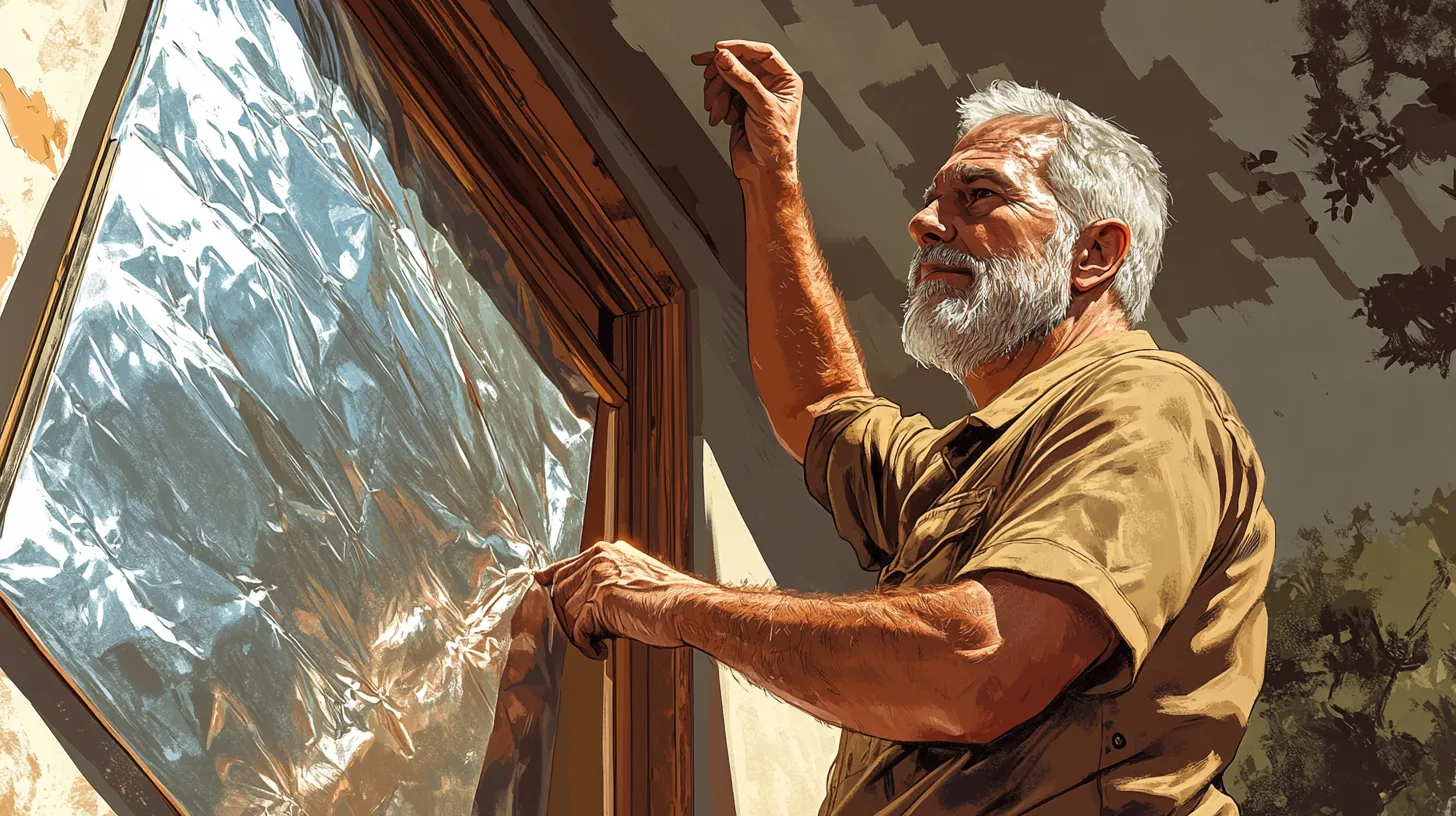
The whole game is simple: stop the heat before it gets into your house. Once the sun's heat is inside, you're stuck fighting it with no AC — but most of that heat pours straight through your windows as sunlight. Block it at the glass and you'll keep a room livable for hours longer, with no power at all.
Block the sun before it gets in
Sun-facing windows are the main way heat enters a home. The single most effective thing you can do without power is reflect that sunlight back outside.
It makes a bigger difference than it sounds. On a hot afternoon with the AC off, a room with an unprotected sun-facing window can turn into an oven in just an hour or two. Block that same window and the room stays noticeably cooler for much longer. It won't replace your AC — it's a small thing — but it's a real buffer when every degree counts.
The cheap roll you cut to fit. Two foil faces reflect most of the sun's radiant heat back outside — no power, no tools, and reusable every season.
Cut foil-faced reflective panels to fit your sunniest windows. The foil bounces most of the sun's radiant heat straight back out — far more effective than a curtain. Keep panels up on south- and west-facing windows during the day.
On any window you don't cover with foil, close the blinds and curtains — light-colored or blackout are best. Anything that stops sunlight from landing on your floors and walls helps.
Shading the glass from the outside (awnings, a tarp, even a beach umbrella) beats blocking it from the inside, because the heat never reaches the glass in the first place.
Reflective panels are about the simplest upgrade there is — no installer, no power, no special tools. Cut a piece to fit with scissors, set it into the window frame, and hold it with a little tape or a few clips. That's it. Compare that to wrestling with peel-and-stick window film or running a portable AC you may not even have power for — and the panels roll back up and reuse season after season.

The foil's dimpled bubbles bounce the sun's radiant heat back outside before it can warm the room. Fit panels into the window frame with a small air gap — not pressed flat against the glass.
Move air the smart way
Once the power's out, the warm air in a closed room just sits there, wrapping around you — and it gets uncomfortable fast. Moving air won't lower the temperature, but it helps your body shed heat, and a small fan by the bed can be the difference between sleeping and sweating all night.
Runs on six D-cell batteries (or AC when you have power), has two speeds, and tilts to point right at you. The maker rates it up to about 40 hours on a set of batteries.
Here's the move: set it on your nightstand, point it at yourself, and run it on low. On low it sips power and runs for many hours on one set of D-cells. Grab a bulk pack of D batteries ahead of time — they come a dozen or two to a box — and when the fan starts to slow down, swap in a fresh set and you're right back up to speed.
A lot of folks plug a regular wall fan into their power station or battery bank overnight. Trouble is, a plug-in fan drains that station fast — and by morning you've got nothing left to charge phones, run a CPAP machine, or keep other essentials going. A D-cell fan sidesteps the whole problem: it runs on cheap batteries you can swap in seconds, so your power station stays reserved for the things that really need it.
Open windows overnight and at dawn when it's coolest, then close everything — windows and blinds — before the day heats up to trap that cooler air inside. Check a simple indoor thermometer so you only open up when it's actually cooler outside than in.
Pick the coolest room — lowest floor, shaded or north side, fewest windows — block its windows, and keep everyone in it during the hottest hours instead of cooling the whole house.
Cool the people, not the whole house
In a heat wave, staying hydrated isn't optional — it's the single most important thing you can do for your body. And after a storm, water is precious: the store shelves are cleared out, the tap may be down or under a boil-water notice, and what you've stored is what you've got. So most folks lay in a few big 5-gallon jugs and figure they're set. Here's the part nobody weighs out first, though — literally. A full 5-gallon jug runs about 42 pounds. That's a serious load for anybody, and a non-starter for the people most likely to be home when the power's out. Grandma isn't hoisting 42 pounds up onto the counter. Little Jimmy and Alice can't get near it. So every time the kids are thirsty, Mom or Dad has to drop what they're doing and go wrestle that bottle — and sooner or later it slips, and half of it ends up across the kitchen floor. On a normal day that's just a mess to mop. With the power out and no easy way to refill, it's water you can't get back.
And here's the fact that turns a hassle into a hazard: when water is hard to get to, a lot of older folks simply go without. The body's thirst signal fades with age, so seniors often don't feel how dry they're getting — and if a drink means wrestling a heavy bottle or risking a spill, many will just skip it. In hot weather that's genuinely dangerous, because the elderly dehydrate faster than the rest of us and it can set in before anyone notices. Making a glass of water effortless isn't only convenient — for an older parent or grandparent, it's one of the simplest things you can do to keep them safe.
This is where a cheap little USB water pump earns its keep. It sits right on top of the jug and does the lifting for you — press the button and water comes out, press it again to stop. Grandma can fill her own glass. The kids can help themselves without anyone hovering. Mom and Dad get to stay out of the 42-pound-bottle business entirely. One USB charge runs for days — sometimes a couple of weeks, depending on how much you use it — so it's not one more thing to babysit. For what it costs, the convenience alone makes it worth it.
Sits on a 2–5 gallon jug and dispenses with one button — no lifting, no tipping, no spills. Recharges by USB and runs for weeks per charge.
It takes about a minute to set up — attach the little spout and food-grade hose, then fasten the unit onto the bottle's neck (it fits most jugs with a standard 2-inch opening, no prying off the cap). Many models even shut off on their own once they've filled a glass. And here's the part that matters most in an outage: when the wall power's gone, you charge it straight off the same power bank you're using to keep your phone alive. A nicer unit uses a stainless-steel spout and food-grade silicone tube so the water stays clean.
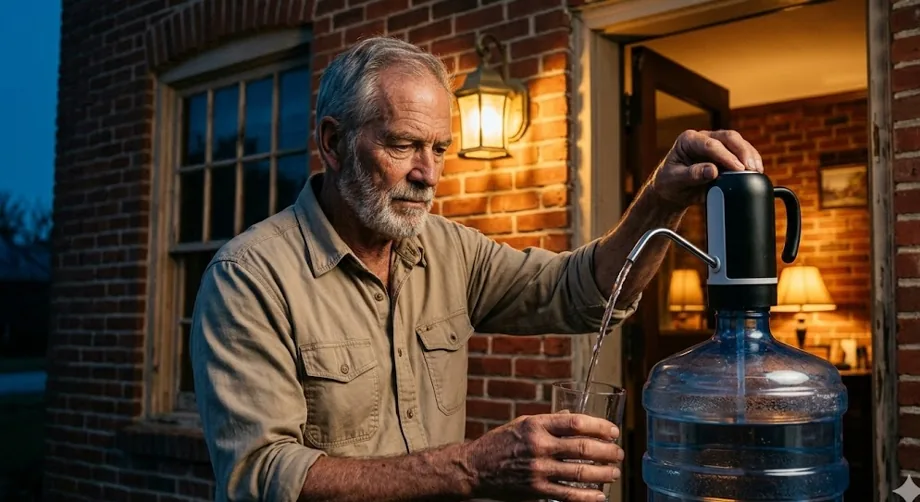
The pump sits on the jug and sends a steady stream into your glass at the press of a button — no wrestling a full 5-gallon bottle.
Beyond the water itself, a few small habits go a long way:
- Drink before you're thirsty — sip steadily through the day, and skip alcohol and caffeine, which dehydrate you.
- Use water on your skin — a damp towel on the neck and wrists, a cool shower, or a spray bottle cools you far faster than cooling the air.
- Dress light — loose, light-colored cotton, and rest during the hottest part of the day rather than doing hard cleanup work in the sun.
Stop making the problem worse
- Skip the oven and stovetop — cook outside on a grill or eat no-cook meals while the power's out.
- Unplug heat-makers — anything that runs warm adds to the room; turn off and unplug what you're not using.
- Open the fridge as little as possible — every opening dumps cold air and adds heat load you don't need.
Keep the meds that need it cold
For a lot of households, a dead fridge is more than a comfort problem — it starts a clock. Insulin is the one everyone knows, but plenty of medications lose their punch if they get too warm, and once the power's out your refrigerator is just an insulated box slowly drifting up toward room temperature. You don't want to be standing in front of a warm fridge wondering whether the vial inside is still any good.
Runs on nothing but water. Soak it a few minutes, tuck your medication inside, and it stays cool for around two days — even in 100°F heat. Re-soak to recharge, over and over.
There's a neat little product made for exactly this, and it's almost too simple. The FRIO wallet isn't an ice pack and it doesn't plug into anything — it cools by evaporation. You soak it in cold water for five to fifteen minutes, the crystals inside swell into a cool gel, you towel it off, slip your medication in, and you've just bought yourself the better part of two days of cool storage — even when it's 100°F out. When it dries out and goes flat, you dunk it again and it's good for another couple of days, over and over. No power, no freezer, no bag of melting ice leaking all over your supplies.
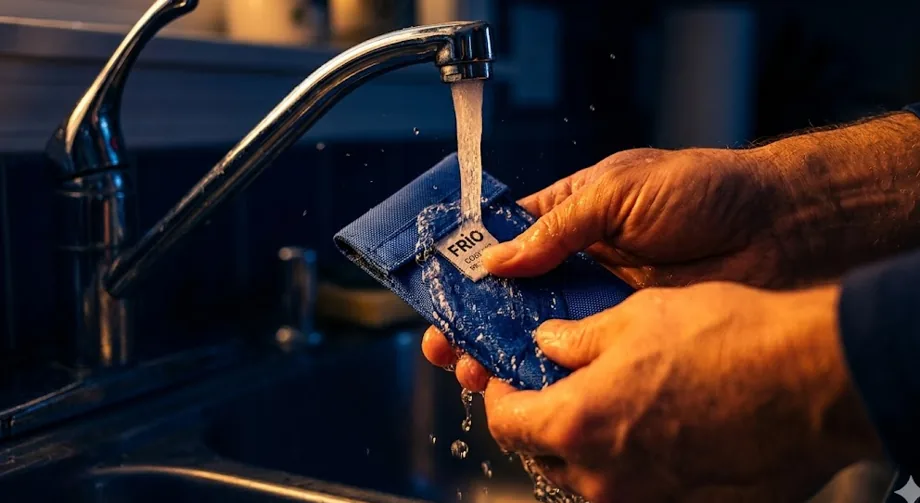
Soak the FRIO under the tap for a few minutes, towel it off, and it keeps your meds cool for about two days — no power, no ice.
Here's the smart move, and it costs you nothing: the moment you hear a storm may be headed your way — or honestly, before hurricane season even starts — call your pharmacist. Ask which of your medications actually need refrigeration, and which simply need to stay at room temperature or below to keep working. Write the answers down and stick the list right on the fridge with one of those magnets. When the power goes, you won't be guessing — you'll know exactly what has to go into the FRIO and what's fine where it sits. Five minutes on the phone, and most of the worry is handled.
And if anyone in the house runs powered medical gear — oxygen, a CPAP, a nebulizer — see our companion guide on keeping medical equipment running in an outage.
Gel packs and a good cooler
Here's something people don't think about until it's too late: after about 60, your body simply doesn't shed heat the way it did at 20. Sweating and circulation — the systems that keep you cool — slow down with age, so an older body can be overheating while it still feels "fine." That's a big part of why a heat wave with no AC is so much more dangerous for seniors. The good news is you can cool a person directly and fast, with something you've known since you were a kid: the humble reusable gel pack.
You've seen these forever — on a ballplayer's pulled hamstring, on a kid's twisted ankle. The same trick cools a body in the heat: lay a cold pack on the spots where the blood runs closest to the skin — the back of the neck, under the arms, the groin, even the wrists — and you chill the blood itself, which cools you all over. It's the same move emergency responders use to bring an overheated person down quickly. Wrap the pack in a thin towel first (never straight on bare skin), hold it on one of those spots, and the relief is almost instant.

A towel-wrapped gel pack on the neck, underarms, or wrists cools the blood close to the skin — the fastest way to bring someone down in the heat.
Cheap, reusable, and the fastest way to cool an overheated person. Grab a 6- or 12-pack so you can treat more than one.
Best part: they're cheap and they last forever. When one warms up, you refreeze it — or just drop it back in a cooler of ice. So don't buy one; get at least six large packs, and a dozen is better. That way you can cool Grandma, Grandpa, and a kid all at once without waiting for one to chill back down. You'll find them at Walmart, Target, or on Amazon.
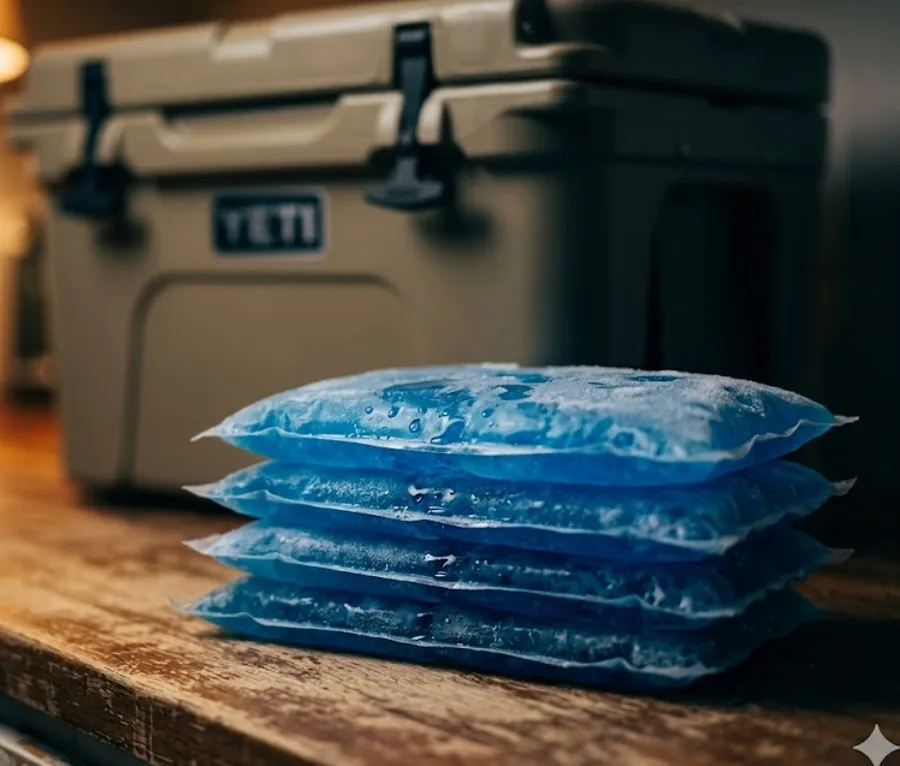
Six at a minimum, a dozen if you can — enough to treat more than one person and keep a fresh cold pack always ready.
The cooler that ties it together
The other half of this is a real cooler — not a flimsy foam box, but a heavy-duty one, the kind you'd take camping, the kind a kid could stand on without cracking the lid. A 20-quart is the sweet spot for a household, and you'll end up using it for far more than you expected.
Tough enough to stand on, holds ice and gel packs for days, and earns its keep long after the storm is over.
Here's the routine. The minute you hear a heat wave or storm is on the way, put your gel packs in the freezer so they're frozen solid and ready. If the power never goes out, no harm done. If it does, that little bit of planning ahead will feel like the smartest thing you did all year. When a pack warms up on someone, it goes back in the cooler with the rest — it won't refreeze in there, but it'll chill back down enough to use again, and you just keep rotating them.
One last trick that makes the cooler work twice as hard: freeze a few bottles of water and pack them into the empty spaces. Dead air in a cooler is wasted space — it's just room for warmth to sneak in. Fill those gaps with frozen bottles and everything stays cold far longer. And when they finally melt, you've got ice-cold drinking water waiting. Nothing goes to waste.
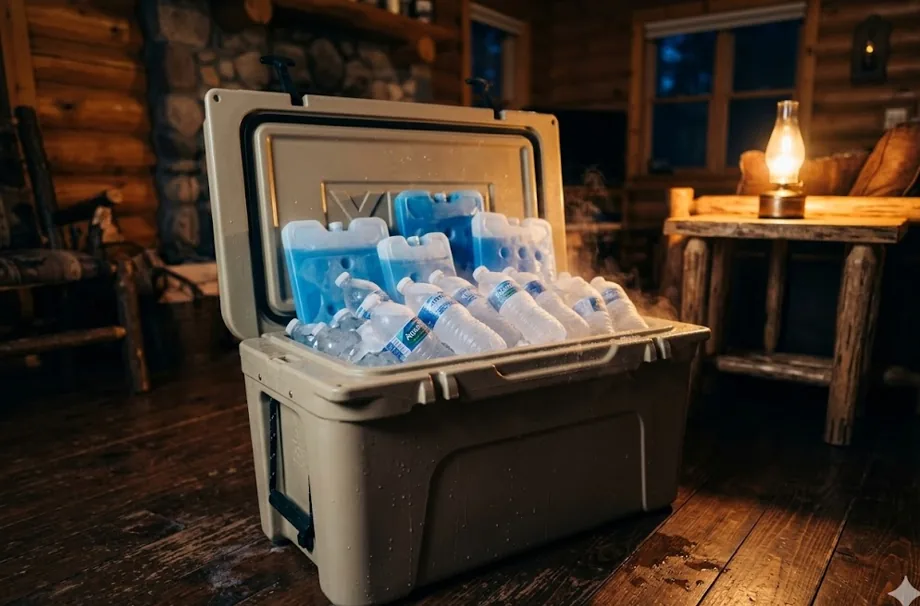
Frozen water bottles fill the empty space so the cold lasts longer — and turn into cold drinking water once they melt.
Watch the vulnerable closely
Heat after a storm is most dangerous for the elderly, infants, anyone on medication, and pets. Check on them often, keep them in the coolest room, and don't wait to act.